

ROV Umbilical Cable Componenets:
What's Inside and Design Explained
Modern ROV operations demand more than a simple electrical cable. These integrated cable systems are commonly used in work-class ROVs, offshore intervention equipment and subsea robotic applications. Learn more about our ROV Umbilical Cable solutions designed for demanding underwater environments.
Unlike a basic tether used for light-duty inspection vehicles, an ROV umbilical is engineered to withstand high tensile loads, repeated bending and harsh subsea environments while supporting mission-critical underwater equipment. Understanding its internal construction helps engineers select the right cable configuration for different offshore and subsea applications.
An ROV umbilical cable connects the surface control system with a remotely operated vehicle (ROV), providing continuous transmission of power, data and control signals throughout underwater operations.
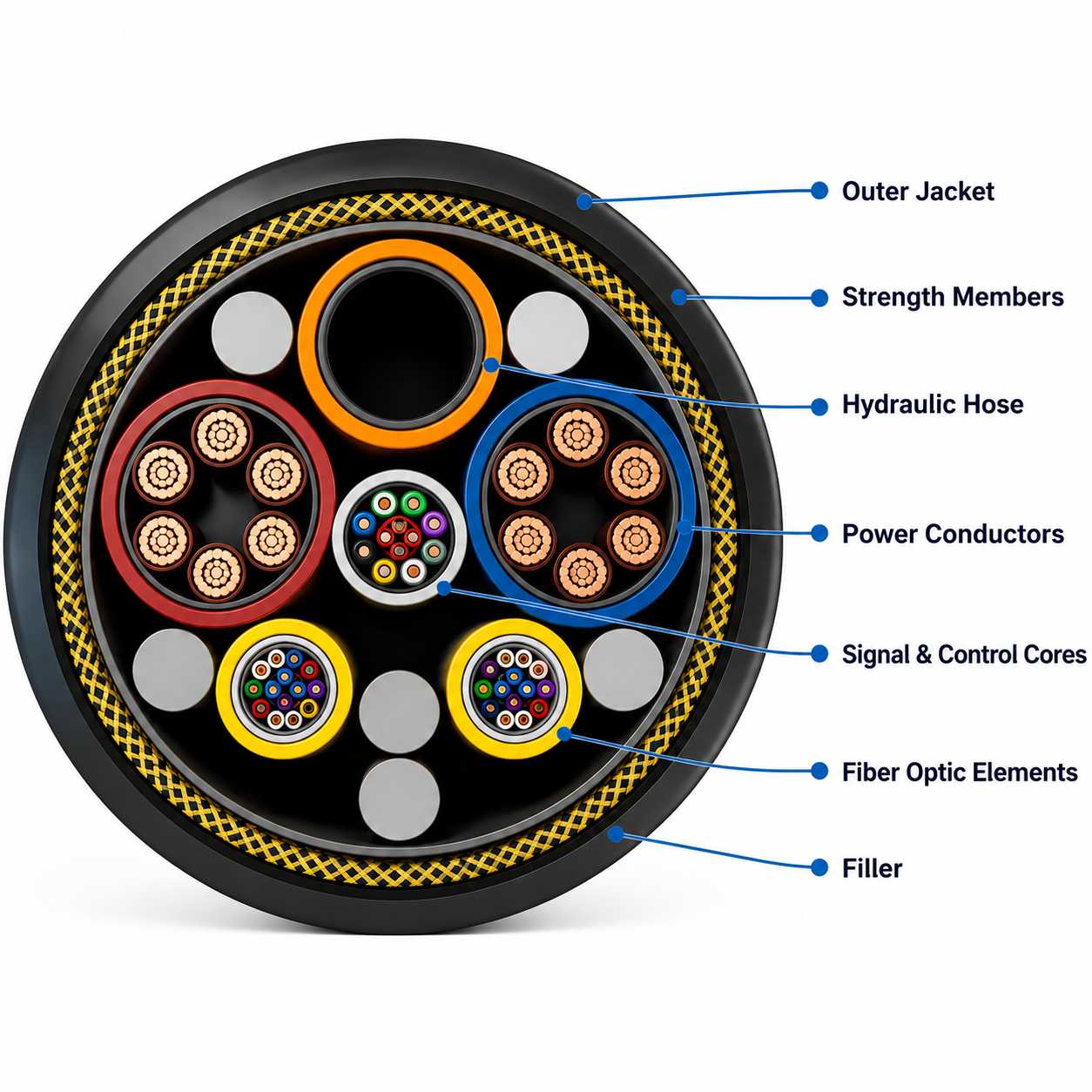
Compared with a conventional ROV Tether Cable, an umbilical cable is typically designed for larger work-class systems requiring higher electrical capacity, longer deployment distances and additional integrated functions such as hydraulic or pneumatic transmission. Depending on the application, an ROV umbilical may include:
Power conductors
Fiber optic elements
Signal and control cores
Hydraulic hoses
Pneumatic tubes
Strength members
Protective outer jacket
The exact configuration is fully customized according to the operational requirements.
ROV Umbilical Cable Components
Power Conductors
Power conductors provide electrical energy from the surface vessel to the ROV and its onboard equipment.
Typical functions include:
Thruster operation
Lighting systems
Cameras
Navigation equipment
Hydraulic power units
Scientific instruments
Conductor size, insulation system and voltage rating are selected according to transmission distance and power demand.
Fiber Optic Elements
Fiber optics enable high-speed, low-latency communication between the operator and the vehicle.
Typical transmitted data includes:
HD video
Sonar data
Navigation information
Sensor outputs
Real-time control feedback
Single-mode optical fibers are commonly used for long-distance subsea communication due to their high bandwidth and low attenuation.
Signal and Control Cores
Signal conductors transmit low-voltage control commands and sensor feedback throughout the system.
They support:
Control circuits
Navigation systems
Instrumentation
Environmental sensors
Auxiliary equipment
Proper shielding is essential to minimize electromagnetic interference (EMI) and ensure reliable signal transmission.
Hydraulic Hoses
Many work-class ROVs rely on hydraulic power to operate manipulators, cutters, torque tools and other subsea intervention equipment.
Instead of installing separate hydraulic lines, high-pressure hydraulic hoses can be integrated directly into the umbilical cable, creating a compact and reliable transmission system. Typical hydraulic applications include:
Manipulator arms
Torque tools
Subsea cutters
Valve operation
Offshore intervention equipment
This integrated configuration is commonly provided through a Hydraulic Umbilical Cable, allowing electrical power, communication and hydraulic fluid to be delivered simultaneously.
Pneumatic Tubes (Optional)
Certain underwater systems require compressed air or gas transmission rather than hydraulic fluid.
Integrated pneumatic tubes are commonly used for:
Air supply systems
Pneumatic actuators
Scientific sampling equipment
Underwater monitoring instruments
These applications are typically served by a Pneumatic Umbilical Cable, where pneumatic lines are combined with electrical and optical transmission within a single cable assembly.
Strength Members
Mechanical strength is one of the most critical aspects of an ROV umbilical. Strength members absorb deployment loads and protect internal components from tensile stress during operation.
Common materials include:
Aramid fiber (Kevlar®)
High-strength synthetic fibers
Steel armor (for specific heavy-duty applications)
The tensile design depends on:
Water depth
Vehicle weight
Deployment method
Dynamic loading conditions
Outer Jacket
The outer jacket protects all internal components against mechanical damage and harsh marine environments.
Typical jacket materials include:
TPU
PUR
PE
Key performance requirements include:
Abrasion resistance
Seawater resistance
Oil and chemical resistance
UV resistance
Long-term flexibility
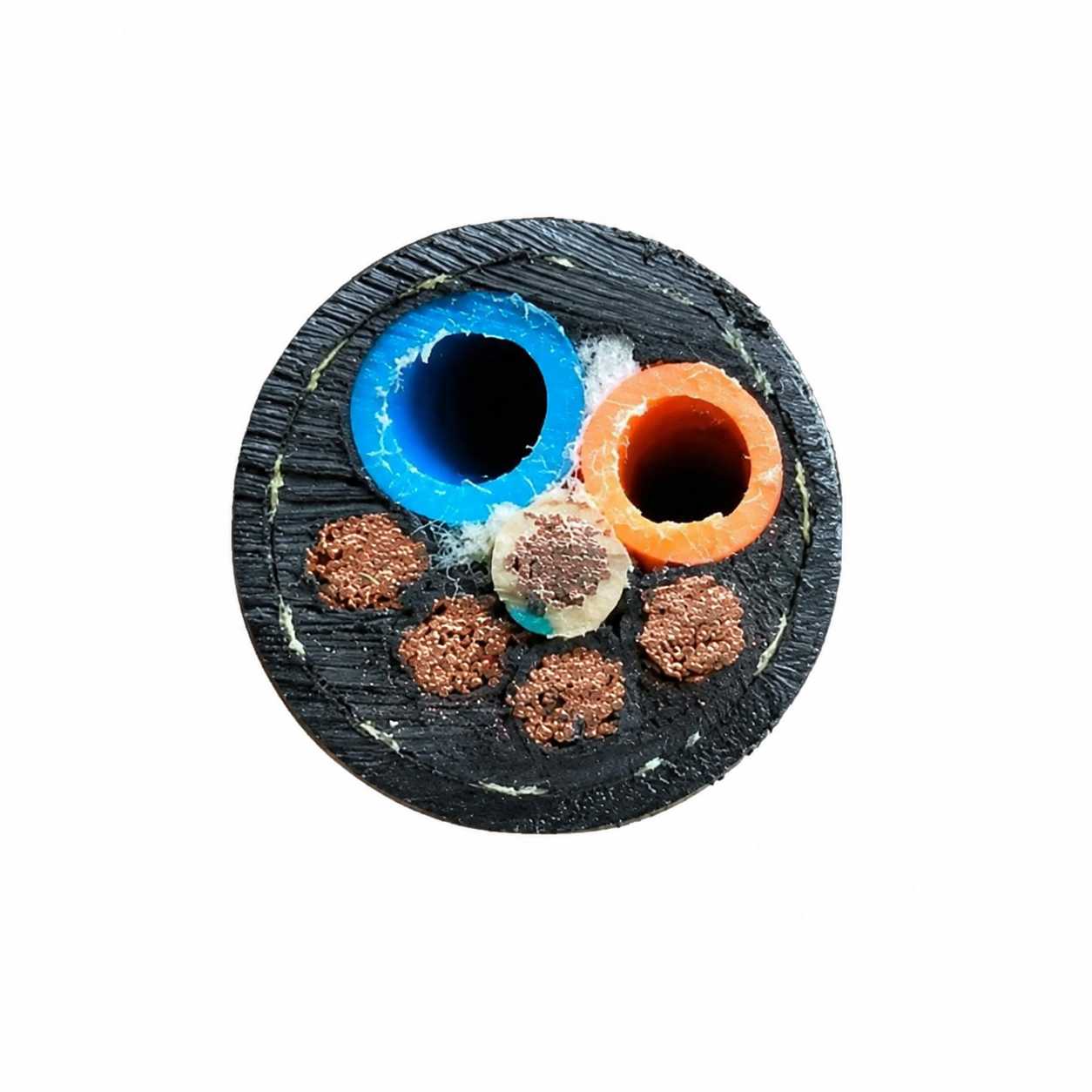
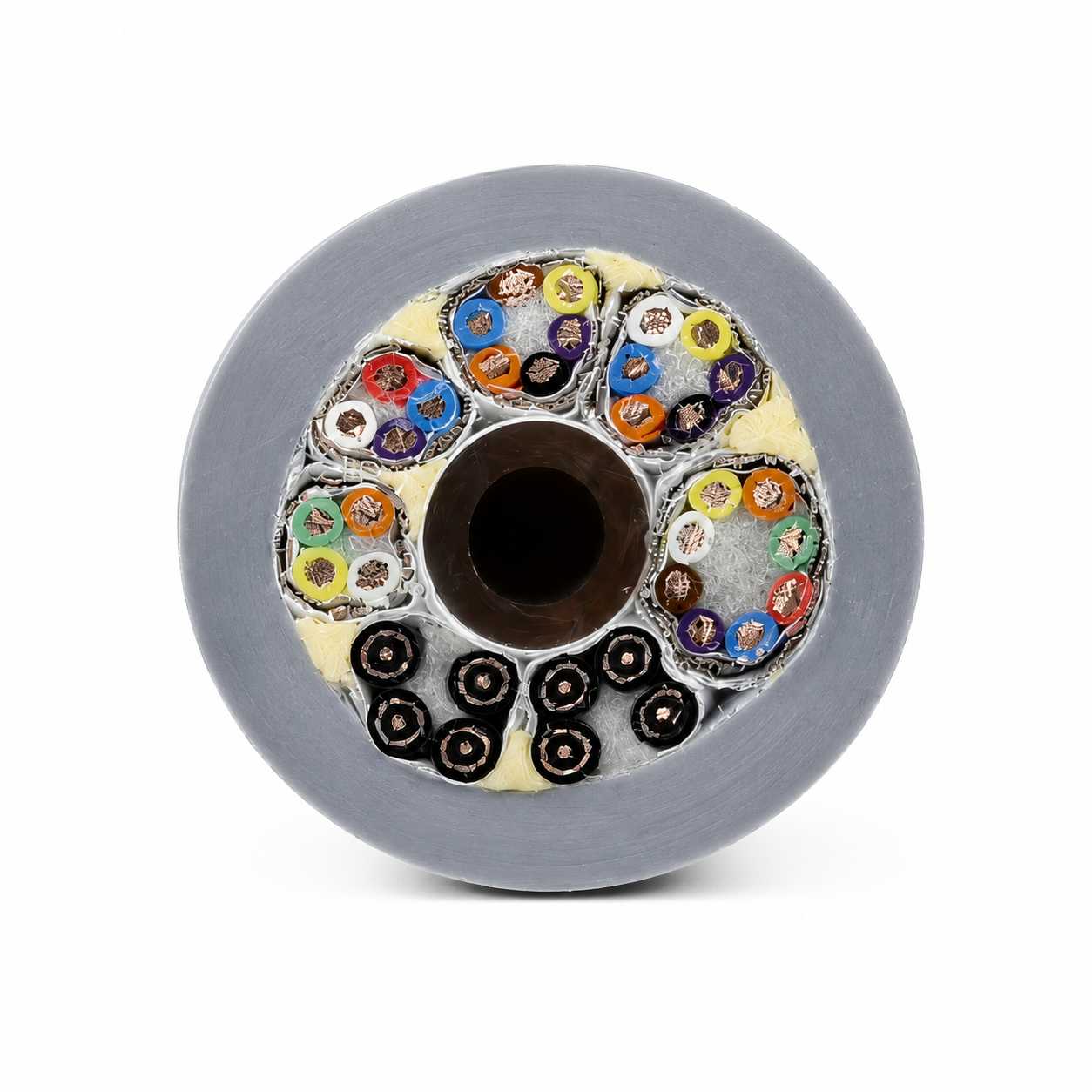
View more pictures of Hydraulic Umbilical Cable & Pneumatic Umbilical Cable
How ROV Umbilical Cable Construction Changes by Application
Different underwater missions require different cable architectures.
Inspection ROVs
Inspection-class vehicles prioritize flexibility and lightweight construction.
Typical configuration:
Power conductors
Fiber optics
Signal cores
Hydraulic transmission is generally unnecessary.
Work-Class ROVs
Work-class ROVs perform demanding subsea intervention tasks and require significantly more complex cable systems.
Additional integrated components often include:
High-pressure hydraulic hoses
Larger power conductors
Higher tensile strength members
Enhanced protective jackets
These systems commonly utilize dedicated Hydraulic Umbilical Cables to support hydraulic tooling during offshore operations.
Scientific and Deep-Sea Research ROVs
Research vehicles often emphasize:
Long deployment lengths
High-bandwidth optical communication
Multiple sensor interfaces
Lightweight construction
Cable design is optimized for stable signal transmission over extended operating depths.
How to Select the Right ROV Umbilical Cable Structure?
Selecting an ROV umbilical requires evaluating several engineering factors.
Operating Depth
Greater water depth increases hydrostatic pressure and mechanical loading, influencing material selection and structural design.
Power Requirements
Conductor size, voltage rating and current capacity should match the electrical demand of the ROV and onboard equipment.
Communication Requirements
Determine the required number of optical fibers, transmission bandwidth and redundancy level based on the mission profile.
Mechanical Performance
Consider:
Tensile strength
Minimum bend radius
Dynamic flex life
Abrasion resistance
Integrated Functions
Depending on the application, the cable may integrate:
Hydraulic hoses
Pneumatic tubes
Ethernet
Coaxial cables
Additional signal pairs
Custom configurations improve installation efficiency while reducing the number of separate subsea connections.
Selecting the Right Umbilical Configuration
Application | Recommended Solution |
General ROV power and communication | |
Hydraulic tools and subsea intervention | |
Pneumatic control systems and instruments |
Custom ROV Umbilical Cable Solutions
Every underwater project presents unique technical challenges. As a custom industrial cable manufacturer, we engineer ROV umbilical cables tailored to specific operational requirements.
Our customization capabilities include:
Power conductor configurations
Fiber optic integration
Signal core layouts
Hydraulic hose integration
Pneumatic tube integration
Tensile strength design
Jacket material selection
Custom cable diameter and length
Whether your project involves offshore construction, subsea intervention, marine research or underwater robotics, a properly engineered umbilical cable ensures reliable power, communication and fluid transmission throughout the system.
If you're looking for a custom ROV umbilical solution, our engineering team can help configure a cable that matches your exact operational and environmental requirements.

Post time:2026-07-10
