

Subsea Cable Materials & Construction
A Complete Guide
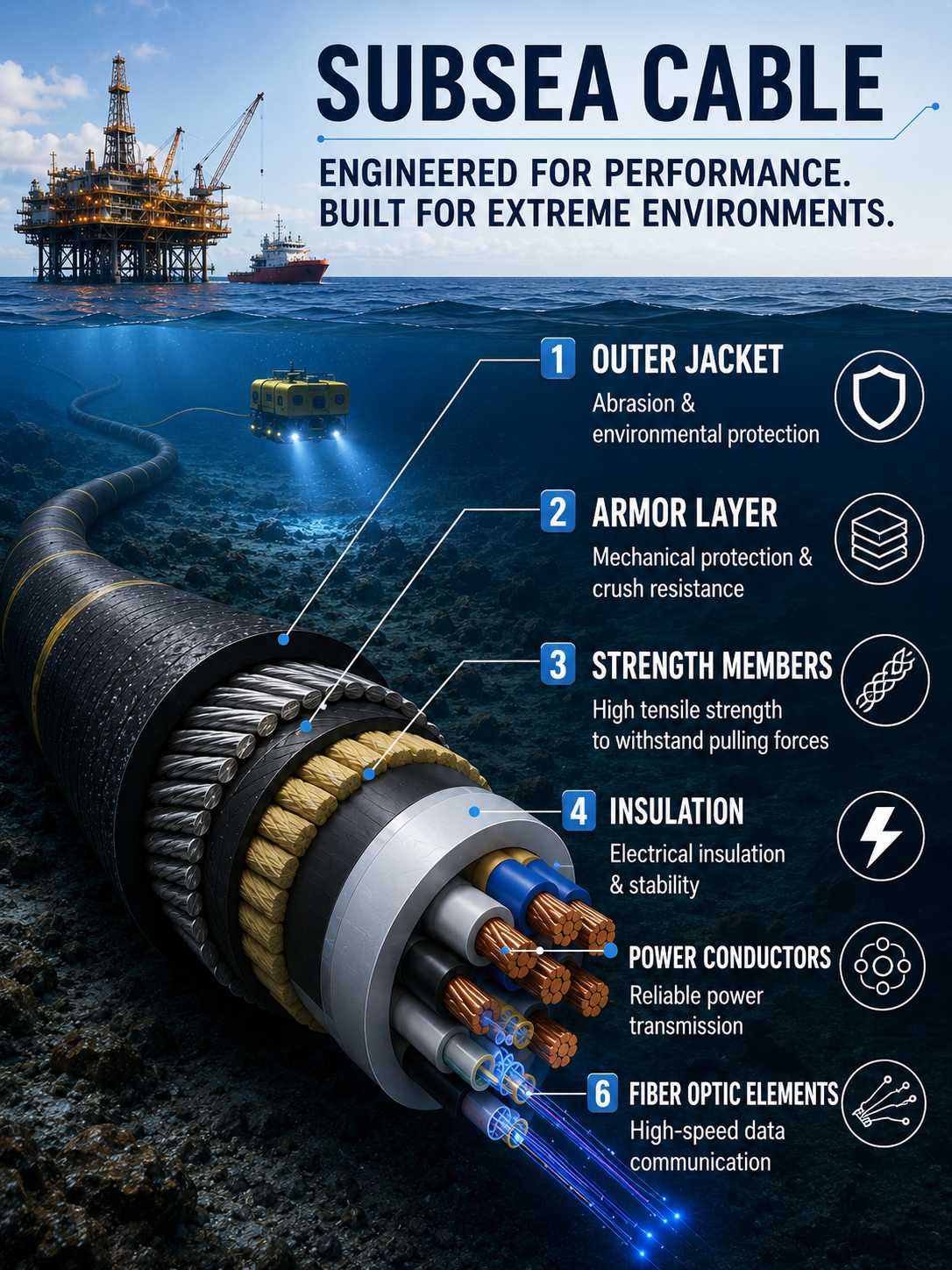
A subsea cable is far more than a waterproof electrical cable. It is a carefully engineered system designed to deliver reliable power, control signals, and data while operating continuously in one of the harshest environments on earth. High hydrostatic pressure, seawater corrosion, mechanical loading, repeated bending, and long service life all influence how a subsea cable is designed.
Unlike standard industrial cables, every layer inside a subsea cable serves a specific engineering purpose. The choice of jacket materials, insulation, strength members, conductors, and optical fibers directly affects reliability, flexibility, durability, and installation performance.
This guide explains how subsea cables are constructed, why different materials are selected, and how their design supports reliable underwater operations.
Why Subsea Cable Construction Matters
A subsea cable must continue operating even after years of exposure to seawater, pressure, abrasion, and continuous mechanical movement. Unlike land-based cables, failure underwater often results in expensive recovery operations and extended system downtime.
For this reason, subsea cable construction focuses on much more than electrical performance. Engineers must balance mechanical strength, flexibility, environmental resistance, weight, and long-term reliability. Every layer within the cable contributes to protecting the conductors while maintaining stable electrical and communication performance throughout its service life.
Rather than relying on a universal design, subsea cables are typically engineered according to the operating environment, installation method, and equipment requirements..
Typical Structure of a Subsea Cable
Although construction varies between applications, most subsea cables contain several functional layers working together.
· Outer Jacket protects the cable from seawater, abrasion, oils, and UV exposure during handling.
· Armor Layer provides mechanical protection against crushing, impact, and external damage.
· Strength Members absorb tensile loads during deployment and recovery.
· Electrical Insulation isolates conductors and maintains dielectric performance.
· Power Conductors transmit electrical energy to underwater equipment.
· Signal Pairs or Fiber Optics provide reliable communication and high-speed data transmission.
· Water Blocking Components prevent moisture migration if the outer jacket is damaged.
Rather than viewing these as independent layers, they should be considered an integrated system where every component contributes to overall cable reliability.
Outer Jacket Materials
The outer jacket is the first line of defense against seawater, abrasion, and environmental exposure. It must maintain flexibility while providing long-term
protection in harsh marine conditions. Common materials include:
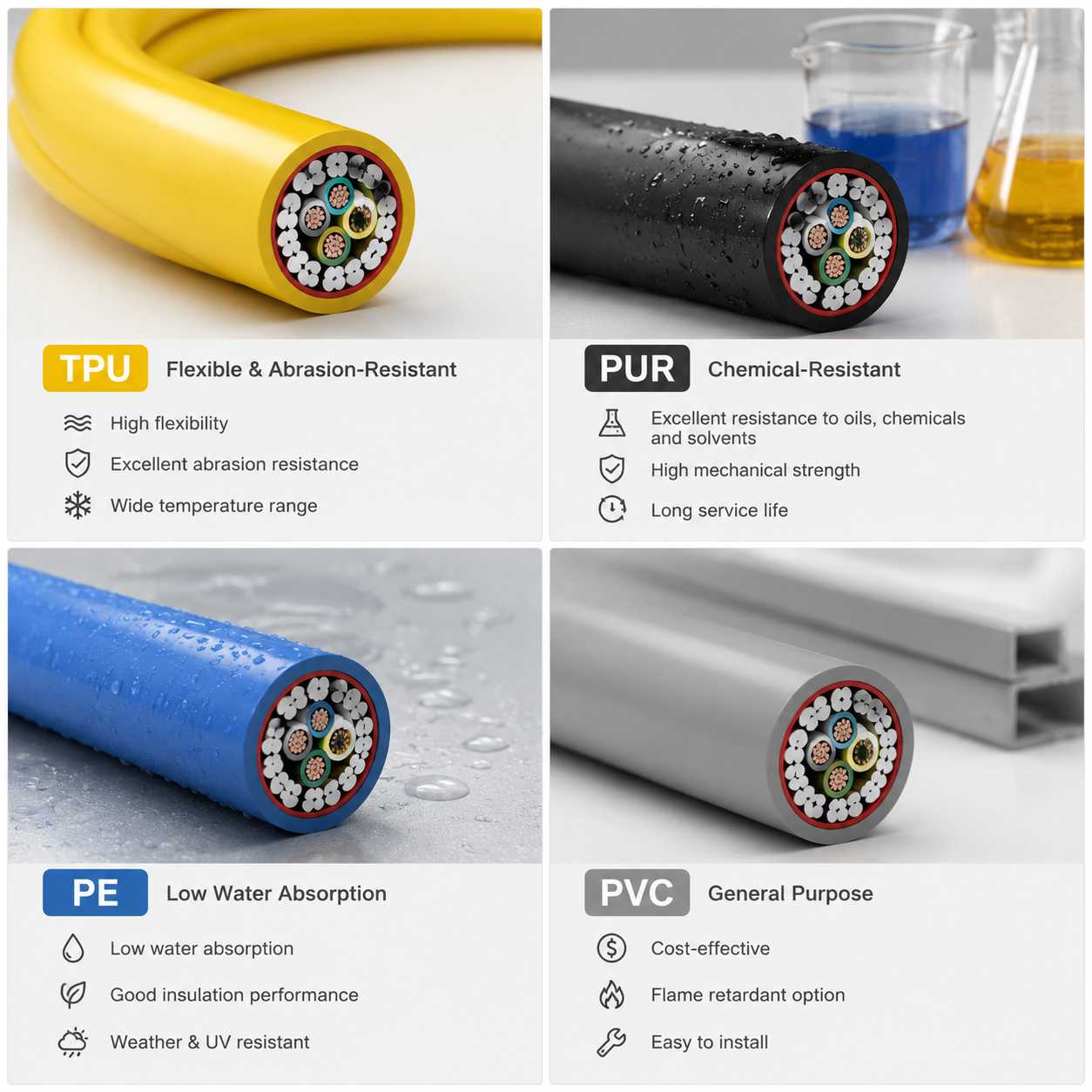 TPU (Thermoplastic Polyurethane)
High abrasion resistance
Excellent flexibility
Good resistance to seawater and oil
Widely used in dynamic subsea applications
PUR (Polyurethane)
Strong resistance to chemicals and seawater
Good mechanical durability
Suitable for industrial marine environments
PE (Polyethylene)
Low water absorption
Good electrical insulation properties
Common in static subsea installations
PVC (Polyvinyl Chloride)
Cost-effective
Limited subsea performance
Used in low-demand or shallow-water applications
The choice of jacket material directly affects cable lifespan, flexibility, and resistance to environmental degradation.
Strength Members and Armor Layers
Mechanical loading is often one of the biggest challenges in subsea applications. During deployment, recovery, or continuous equipment movement, cables may experience significant tensile forces.
To prevent conductor damage, dedicated strength members are incorporated into the cable structure.
Common reinforcement materials include:
· Aramid yarn
· Kevlar® fibers
· Steel wire armor
· Steel braid
The choice depends on the application's tensile requirements, flexibility, weight limitations, and installation conditions.
Dynamic systems generally prioritize flexibility and fatigue resistance, while static installations often require higher mechanical protection against external impacts.
Conductors and Insulation Systems
Conductors and insulation layers are responsible for electrical power transmission and signal integrity.
Conductors
Copper
High electrical conductivity
Standard choice for power transmission
Tinned Copper
Improved corrosion resistance
Better suited for marine environments
Insulation Materials
XLPE (Cross-Linked Polyethylene)
Excellent electrical insulation
High thermal resistance
Widely used in subsea power cables
EPR (Ethylene Propylene Rubber)
High flexibility
Good dielectric properties
Suitable for dynamic systems
Silicone-based insulation
High temperature resistance
Flexible under extreme conditions
Insulation systems ensure stable electrical performance even under high pressure and long-term exposure to seawater.
Conductors and Insulation Systems
Power conductors are typically manufactured from bare or tinned copper to provide stable electrical performance and corrosion resistance. Depending on voltage requirements, insulation materials such as XLPE or EPR are selected to maintain electrical integrity under demanding operating conditions.
Modern subsea systems increasingly require more than electrical power alone. Cameras, sonar systems, navigation equipment, and real-time monitoring devices all depend on reliable high-speed communication. As a result, optical fibers are now integrated into many subsea cable designs, allowing power and data to be transmitted simultaneously without increasing installation complexity.
For projects requiring long-distance, high-bandwidth underwater communication, dedicated Fiber Optic Subsea Cables provide enhanced signal integrity and are specifically designed for demanding marine environments.
Why Hybrid Cable Design Is Becoming the Industry Standard
Many underwater systems no longer require only electrical power or only data communication. Modern ROVs, subsea sensors, offshore monitoring systems, and oceanographic equipment often need multiple transmission functions within a single cable.
Instead of installing separate power, signal, and fiber optic cables, engineers increasingly specify hybrid cable designs that integrate all required transmission media into one compact solution.
A well-designed Hybrid Subsea Cable simplifies installation, reduces cable weight and connection points, improves reliability, and makes future system expansion easier. More importantly, hybrid construction can be fully customized to match conductor count, voltage level, fiber configuration, shielding requirements, and mechanical performance for specific underwater applications.
How Materials Affect Subsea Cable Performance
Each material selection directly influences how a subsea cable performs in real-world conditions.
Key performance relationships:
Abrasion resistance → jacket material selection (TPU, PUR)
Pressure resistance → armor and structural layers
Flexibility → insulation and strength member design
Corrosion resistance → conductor coating and jacket material
Tensile strength → armor and aramid reinforcement
Electrical stability → insulation system quality
In practice, subsea cable design is always a trade-off between mechanical strength, flexibility, weight, and cost. This is why most high-performance applications require custom-engineered cable solutions rather than standard off-the-shelf products.
FAQ
Why is TPU commonly used in subsea cables?
TPU offers excellent abrasion resistance, flexibility, and seawater durability, making it ideal for dynamic underwater environments.
What is the purpose of armor in a subsea cable?
Armor protects the internal structure from mechanical damage, tensile stress, and external pressure during installation and operation.
Can subsea cables include fiber optics?
Yes. Many modern subsea cables integrate fiber optics for high-speed communication and data transmission, especially in hybrid designs.
How is water prevented from entering subsea cables?
Water-blocking materials, sealed jackets, and layered construction prevent moisture migration and protect internal conductors.
Whether your application requires a lightweight dynamic tether, a high-strength armored cable, or a customized hybrid solution combining power, signal, and fiber optics, selecting the right materials and construction is critical for long-term underwater reliability. Our engineering team can develop subsea cable solutions tailored to your operating environment, electrical requirements, and mechanical performance.

Post time:2026-07-06
