

Work Class ROV Umbilical Cable
Voltage Ratings & Standards
Work class ROV systems rely on high-performance ROV umbilical cables to provide power transmission, control signals, and communication between the surface vessel and subsea vehicle. Selecting the correct ROV umbilical cable voltage ratings is essential for efficient power delivery, reduced transmission losses, and reliable subsea operation.
A Work Class ROV Umbilical Cable is designed for demanding applications such as offshore construction, inspection, intervention, and maintenance. These systems require high power levels, making high-voltage transmission through the umbilical a key solution for long-distance subsea operations.
Typical voltage levels include 3 kV, 6 kV, and 11 kV AC/DC configurations. The selected voltage rating depends on power requirements, cable length, conductor size, efficiency, and operational safety.
Understanding ROV Umbilical Cable Voltage Ratings
ROV Umbilical Cable Voltage Ratings define the electrical voltage level that an umbilical system is designed to safely transmit. Voltage selection directly affects power capacity, conductor design, insulation requirements, and overall cable performance.
Higher voltage allows power to be transmitted with lower current, reducing voltage drop and improving efficiency over long subsea distances. However, the final selection must also consider cable diameter, weight, flexibility, and deployment conditions.
The Umbilical: More Than a Power Cable
An ROV umbilical cable is an integrated subsea connection system that combines multiple functions, including:
Power conductors for ROV operation
Fiber optic elements for data communication
Signal conductors for control systems
Hydraulic or pneumatic conduits
Strength members and protective layers
This engineered structure enables reliable power, control, and communication for work class ROV operations in demanding underwater environments.
Common Voltage Levels for Work Class ROV Umbilical Cable Systems
The voltage level of a Work Class ROV Umbilical Cable depends on ROV power demand, cable length, and operational requirements. Different voltage configurations are selected to achieve reliable power transmission and efficient subsea operation.
Low Voltage Systems
Low voltage systems are commonly used for compact ROVs and applications with limited power requirements, such as inspection and observation tasks.
Medium Voltage Systems
Medium voltage configurations are widely used in work class ROV applications. They provide higher power transmission efficiency by reducing current and minimizing transmission losses over longer cable distances.
High Power Subsea ROV Systems
High-power work class ROV systems for offshore construction, intervention, and subsea tooling require higher voltage solutions to support powerful thrusters, hydraulic systems, and other demanding equipment.
The final voltage selection depends on the complete ROV system design and operating environment.
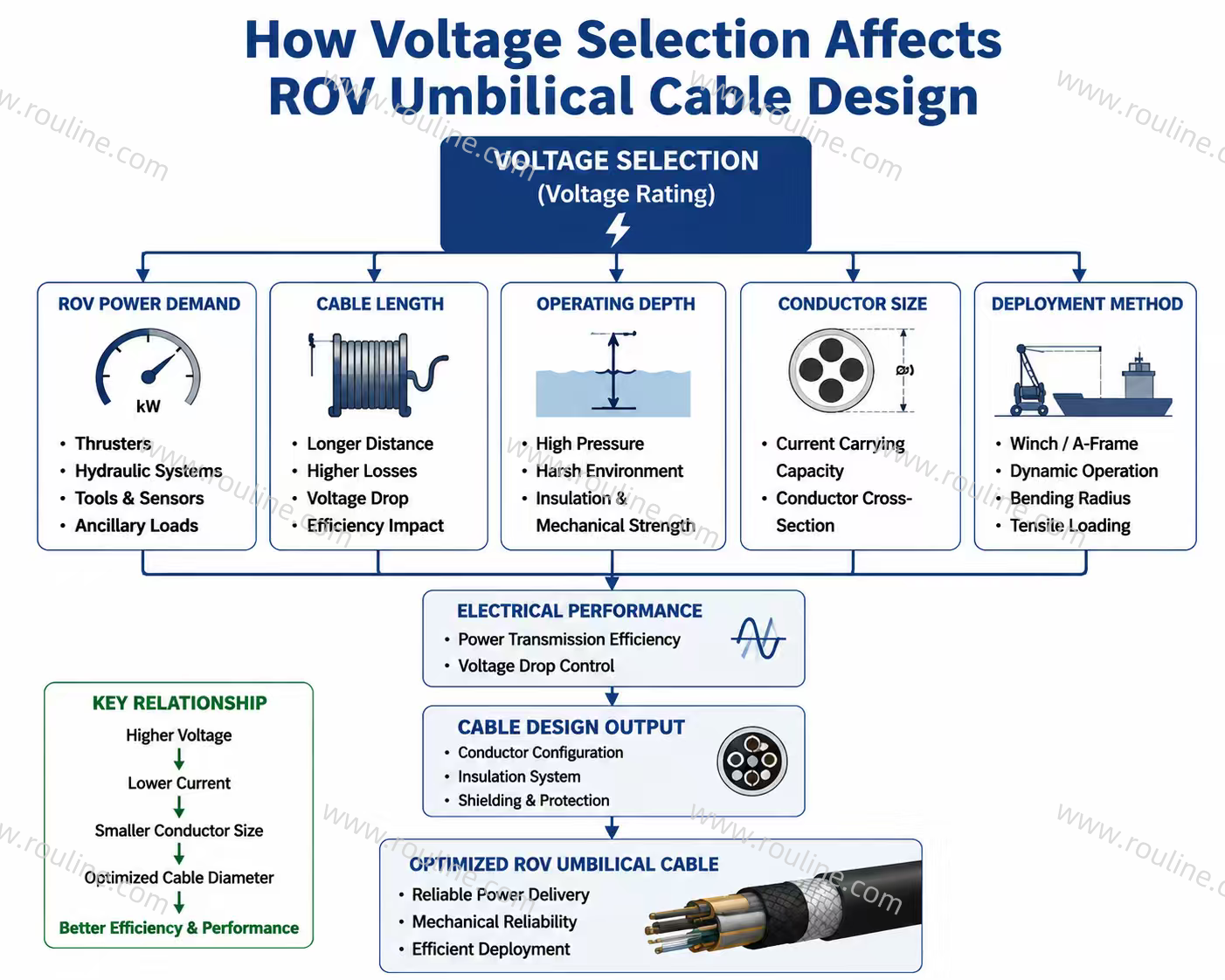
How Voltage Selection Affects ROV Umbilical Cable Design
Voltage selection directly influences ROV umbilical cable design, including electrical performance, cable size, and deployment capability. Key factors include:
Operating Depth
Deepwater applications require reliable insulation, mechanical strength, and long-term performance under harsh subsea conditions.
Cable Length
Longer deployments require optimized voltage levels to reduce voltage drop and improve power transmission efficiency.
ROV Power Demand
The required voltage depends on system loads such as thrusters, hydraulic units, sensors, and subsea tools.
Conductor Size & Deployment Method
Voltage selection affects conductor configuration, cable diameter, weight, flexibility, and mechanical reinforcement requirements.
A properly designed ROV Umbilical Cable balances power capability, mechanical performance, and operational reliability.
Custom ROV Umbilical Cable Voltage Solutions
Every subsea application has different requirements for power transmission, communication, and mechanical performance. We provide custom ROV umbilical cable solutions designed according to each customer's specific operating conditions, including voltage requirements, ROV power demand, cable length, and deployment environment.
Our engineering team works with customers to optimize cable structure, conductor configuration, and integrated functions to achieve the best balance between electrical performance, mechanical reliability, and operational flexibility. Custom solutions can include:
Custom conductor configuration for different voltage and power requirements
Hybrid power and signal cable designs
Fiber optic integration for high-speed communication
Armored structures for demanding subsea applications
By combining electrical design and mechanical engineering, we provide customized umbilical solutions for work class ROV systems, subsea intervention, and deepwater operations.
FAQ
What voltage is used in a Work Class ROV Umbilical Cable?
A Work Class ROV Umbilical Cable typically uses voltage levels such as 3 kV, 6 kV, or 11 kV AC/DC, depending on the ROV power requirements, cable length, and subsea application. Higher voltage configurations are commonly used for deepwater and high-power ROV systems to improve transmission efficiency over long distances.
How do I choose the voltage rating for an ROV umbilical cable?
Selecting the correct ROV Umbilical Cable Voltage Ratings depends on several factors, including ROV power demand, operating depth, cable length, conductor size, and deployment conditions. A properly selected voltage level helps balance power capacity, cable size, efficiency, and overall system reliability.
Does higher voltage reduce ROV umbilical cable size?
Higher voltage can help reduce conductor size because it allows the same power to be transmitted with lower current. However, the overall ROV umbilical cable size also depends on insulation requirements, mechanical strength, fiber optic integration, armor structure, and other design factors.
Post time:2026-01-08
