

Flat vs Round Elevator Traveling Cable
Key Differences and Selection Guide
Elevator systems rely on a traveling cable to ensure continuous transmission of power, control signals, and data between the control cabinet and the elevator car. In modern elevator engineering, the two most common types are flat and round elevator traveling cables, each designed for different installation conditions, building heights, and performance requirements. This article compares flat vs round elevator traveling cable in terms of structure, flexibility, installation, and application scenarios, helping you choose the most suitable solution for your elevator system.
1. Why Elevator Traveling Cable Structure Matters
The structure of an elevator traveling cable plays a critical role in overall elevator performance and reliability. During operation, the cable is subjected to continuous bending cycles, making flexibility and fatigue resistance essential for long service life. Cable design also affects signal stability, especially when transmitting control signals, CCTV data, and communication signals. In addition, installation space inside the hoistway may limit cable movement and influence cable selection. Electromagnetic interference (EMI) generated by variable frequency drives can further impact signal quality. These factors make the choice between flat and round elevator traveling cables an important engineering decision.
2. What Is Flat Elevator Traveling Cable?
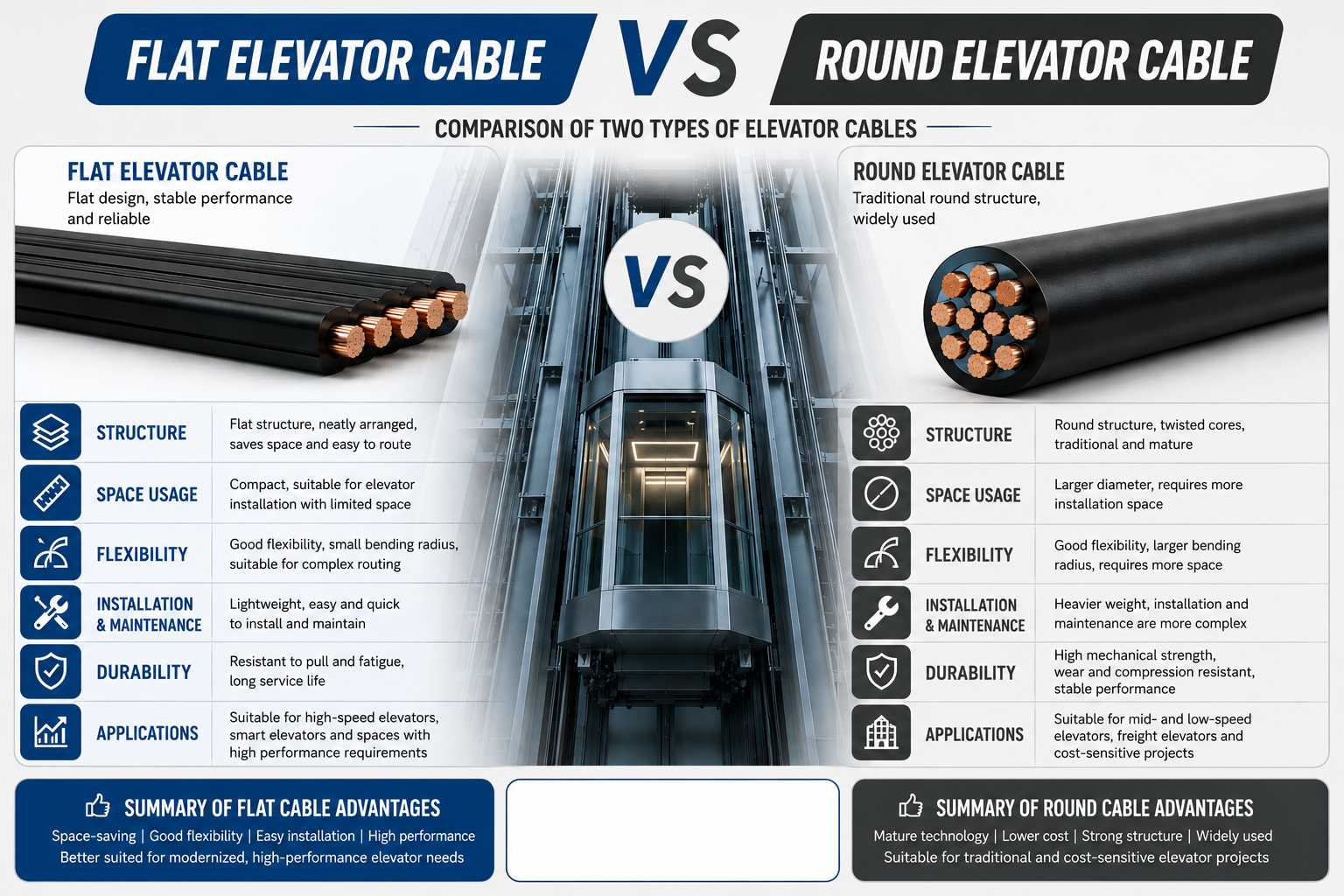
Flat elevator traveling cable is a ribbon-type cable designed with conductors arranged in a side-by-side structure. It is widely used in low-rise and residential elevator systems due to its high flexibility and compact bending radius.
Key Advantages of Flat Elevator Traveling Cable
· Ribbon structure for enhanced flexibility and organized conductor arrangement
· Small bending radius for smooth and reliable repeated movement
· Flexible installation in compact elevator shafts and space-constrained systems
· Reduced cable swing during operation, improving stability and wear resistance
· Ideal for low-rise elevators, residential buildings, and home lift applications
· Supports integrated power, control, and communication functions within a single flat elevator cable system
This optimized design has made the flat elevator traveling cable one of the most widely used cable solutions in modern residential and low-rise elevator installations.
3. What Is Round Elevator Traveling Cable?
A round elevator traveling cable is designed with a concentric layered structure. This construction provides excellent mechanical strength and allows the cable to accommodate a large number of power, control, and communication cores within a compact diameter.
Limitations of Round Cable
While round cables offer advantages in specific high-rise applications, they may not be the most efficient solution for every elevator project.
· higher cost
· larger bending radius
· complex installation
· over-spec for low-rise systems
4. Flat Cable vs Round Cable Comparison Table
Feature | Flat Cable | Round Cable |
Flexibility | High | Medium |
Installation | Easy | Complex |
Cost | Lower | Higher |
Best Use | Low-rise | High-rise |
Flat elevator traveling cables are generally preferred for residential and low-rise elevator systems due to their flexibility and installation advantages, while round cables are more suitable for high-rise and high-load applications.
5. How to Choose the Right Elevator Traveling Cable
When selecting an elevator traveling cable, engineers should consider:
· Building height
· Elevator speed
· Installation space
· Signal complexity
· EMI environment
Flat cable is recommended for most residential and low-rise elevators
Round cable is mainly used for high-rise systems
6. Recommended Product: Flat Elevator Traveling Cable
For most residential and low-rise elevator applications, flat elevator traveling cable provides the most cost-effective and flexible solution.
[View Flat Elevator Traveling Cable Product →]
7. Conclusion
The choice between flat vs round elevator traveling cable depends on building height, system complexity, and performance requirements. In most residential and low-rise applications, flat elevator traveling cable is the preferred solution due to its flexibility and cost efficiency.
Post time:2026-06-18
