

Why Ultra-Flexible ROV Cable Is Essential for Dynamic Underwater Operations
Introduction
Modern ROVs are expected to perform increasingly complex underwater tasks, from offshore platform inspections and pipeline surveys to scientific research and subsea intervention. Unlike static subsea cables, an ROV Tether is constantly moving with the vehicle, bending, twisting, looping, and changing direction throughout every mission.
In these dynamic conditions, cable flexibility directly affects vehicle control, operational safety, and cable service life. An ultra-flexible ROV cable is not simply a softer cable, it is an engineering solution designed to overcome the mechanical challenges.
Explore the details of our Ultra Flexible ROV Cable.
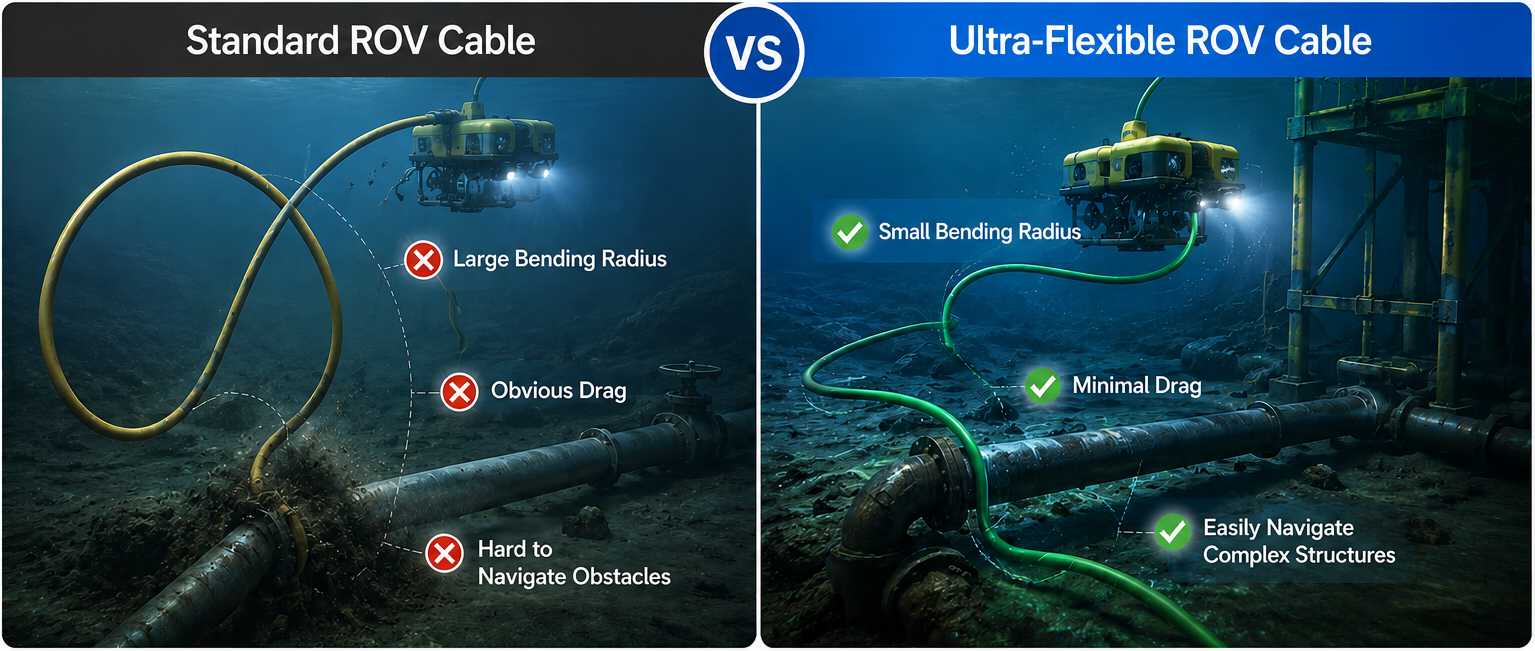
Why Flexible ROV Cable Matters for Underwater Inspection
Unlike fixed subsea installations, an ROV cable rarely remains in a straight line. During normal operation, the tether continuously responds to vehicle movement, water currents, launch and recovery systems, and surrounding subsea structures.
Typical operating scenarios include:
Navigating around offshore platforms and subsea equipment
Inspecting pipelines with frequent changes in direction
Entering confined spaces for structural inspection
Continuous launch and recovery from tether management systems (TMS)
Long-duration missions with thousands of bending cycles
Because the ROV tether is always in motion, flexibility becomes one of the most important mechanical characteristics of an ROV cable.
What Problems Does an Ultra-Flexible ROV Cable Solve?
Instead of simply improving flexibility, a high-flex cable addresses several common challenges encountered during underwater operations.
1. Reduces ROV Tether Drag During Vehicle Maneuvering
A rigid tether creates resistance as the ROV turns or changes direction. This additional drag can reduce maneuverability and make precise positioning more difficult.
An ultra-flexible cable naturally follows the vehicle's movement, reducing drag forces and allowing smoother, more accurate control, particularly during inspection tasks that require slow and precise navigation.
2. Minimizes Stress from Continuous Bending
Every dive subjects the tether to repeated bending. Without sufficient flexibility, mechanical stress concentrates in the conductors and reinforcement layers, accelerating fatigue and increasing the risk of premature failure.
A flexible cable distributes these stresses more evenly, helping extend operational life and improve long-term reliability.
3. Reduces Cable Twisting, Looping, and Temporary Knotting
During deployment and recovery, ROV tethers often develop loops, twists, or accidental knots, especially in rough sea conditions or confined working environments.
A highly flexible cable is easier to handle and adapts more naturally to changing cable paths, reducing excessive mechanical stress caused by these conditions and making deck operations more efficient.
4. Improves Operation in Confined Underwater Spaces
Many inspection tasks require the ROV to work inside structures where cable movement is heavily restricted. Examples include:
Offshore platform jackets
Ship hull inspections
Ballast tanks
Subsea manifolds
Pipeline crossings
A flexible ROV umbilical cable bends more easily around obstacles, allowing the vehicle to maintain stable movement without excessive pulling forces from the cable.
5. Supports More Stable Power and Data Transmission
An ROV umbilical cable carries far more than electrical power. It often integrates fiber optics, control signals, real-time video, sonar, and navigation data within a single tether.
By reducing internal mechanical stress during continuous movement, an ultra-flexible construction helps maintain stable electrical and optical performance throughout long operating cycles.
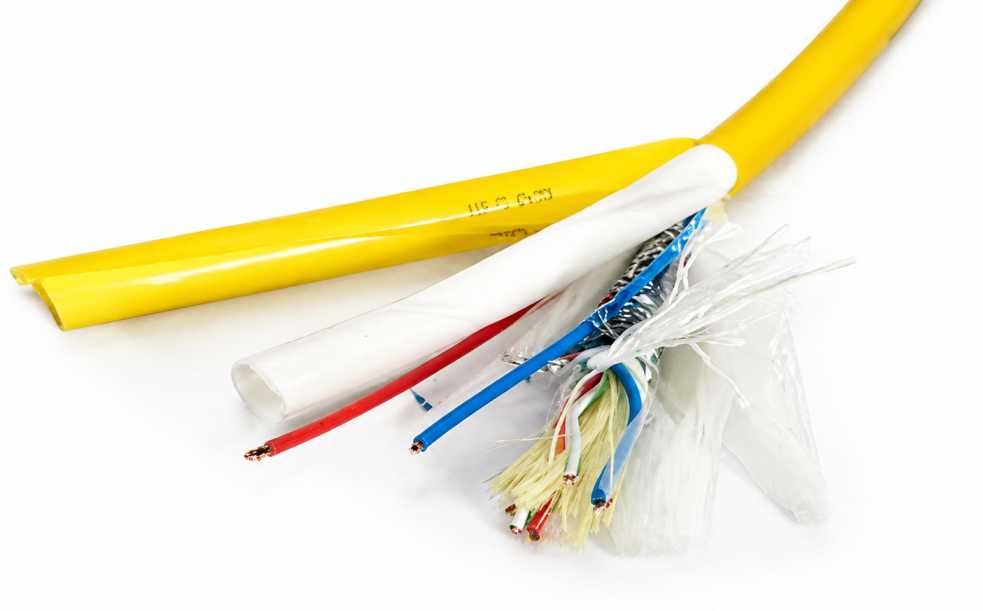
Why Flexibility Directly Improves ROV Performance
For underwater robotics, the tether behaves as part of the overall system rather than as a passive component. A cable that moves naturally with the vehicle helps achieve:
Better maneuverability
More precise positioning
Lower mechanical loading on the vehicle
Easier deployment and recovery
Reduced maintenance requirements
Longer cable service life
Improved operational efficiency
These benefits become increasingly important as ROV missions grow longer and more technically demanding.
How Engineers Evaluate the Flexibility of an ROV Umbilical Cable
For ROV applications, cable flexibility is evaluated by engineering performance rather than how soft the cable feels. A high-flex ROV cable must withstand continuous underwater movement while maintaining reliable power and data transmission.
Engineers typically assess flexibility using the following key indicators:
Minimum Bend Radius – A smaller bend radius allows the cable to move more easily through tight spaces, around subsea structures, and within tether management systems (TMS).
Continuous Flex Life – Measures how well the cable withstands repeated bending cycles during long-term ROV operations without premature fatigue.
Torsion Resistance – Evaluates the cable's ability to tolerate twisting forces caused by vehicle movement, ocean currents, and deployment.
Kink Resistance – Indicates how well the cable resists permanent deformation from looping, twisting, or accidental knotting during launch and recovery.
Deployment Cycle Performance – Assesses whether the cable can maintain consistent mechanical and electrical performance after thousands of deployment and retrieval cycles.
Rather than focusing on flexibility alone, engineers evaluate how well a cable maintains its structural integrity and transmission reliability under real subsea operating conditions. This comprehensive approach ensures the tether can support demanding ROV missions with greater durability and long-term performance.
Applications That Benefit Most from Ultra-Flexible ROV Cable
Ultra-flexible cable designs provide significant advantages in applications involving frequent movement and continuous cable handling, including:
Offshore oil and gas inspection
Underwater pipeline surveys
Marine scientific research
Port and harbor inspection
Ship hull maintenance
Underwater robotics
Aquaculture monitoring
Sonar and underwater imaging systems
Environmental monitoring missions
In these applications, cable flexibility contributes directly to operational efficiency and mission reliability.
Is an Ultra-Flexible ROV Cable the Right Choice?
Not every subsea application requires maximum flexibility. Static installations or heavily armored deep-water systems may prioritize tensile strength or external protection over bending performance.
However, if an ROV system experiences continuous movement, repeated deployment cycles, frequent maneuvering, or operation in confined underwater environments, an ultra-flexible tether can significantly reduce mechanical stress while improving overall system performance.
The ROV tether cable helps solve many of the mechanical challenges encountered during real underwater operations, including cable drag, repeated bending, twisting, restricted movement, and long-term fatigue. By allowing the tether to move more naturally with the vehicle, a high-flex design improves maneuverability, enhances transmission reliability, and extends service life.
As underwater robotics continue to take on more demanding inspection and intervention tasks, cable flexibility has become a critical engineering consideration rather than simply an optional feature.
Need a Custom ROV Cable Solution?
We provide engineered ROV cable systems designed for offshore energy, subsea robotics, and deep-sea exploration applications. Contact our engineering team for technical consultation, datasheets, or customized cable design support.
Post time:2026-06-29
