

ROV Umbilical Cable vs ROV Tether
What’s the Difference?
ROV Umbilical Cable and ROV Tether are both used to connect underwater remotely operated vehicles with power, data and control systems, but they perform different roles within an ROV system.
The ROV umbilical forms the main connection between the surface system and the TMS, while the ROV tether connects the TMS to the ROV itself. This difference in system position determines their construction, mechanical requirements, buoyancy and cable design.
In a typical work-class ROV system:
Surface Vessel → ROV Umbilical → TMS → ROV Tether → ROV
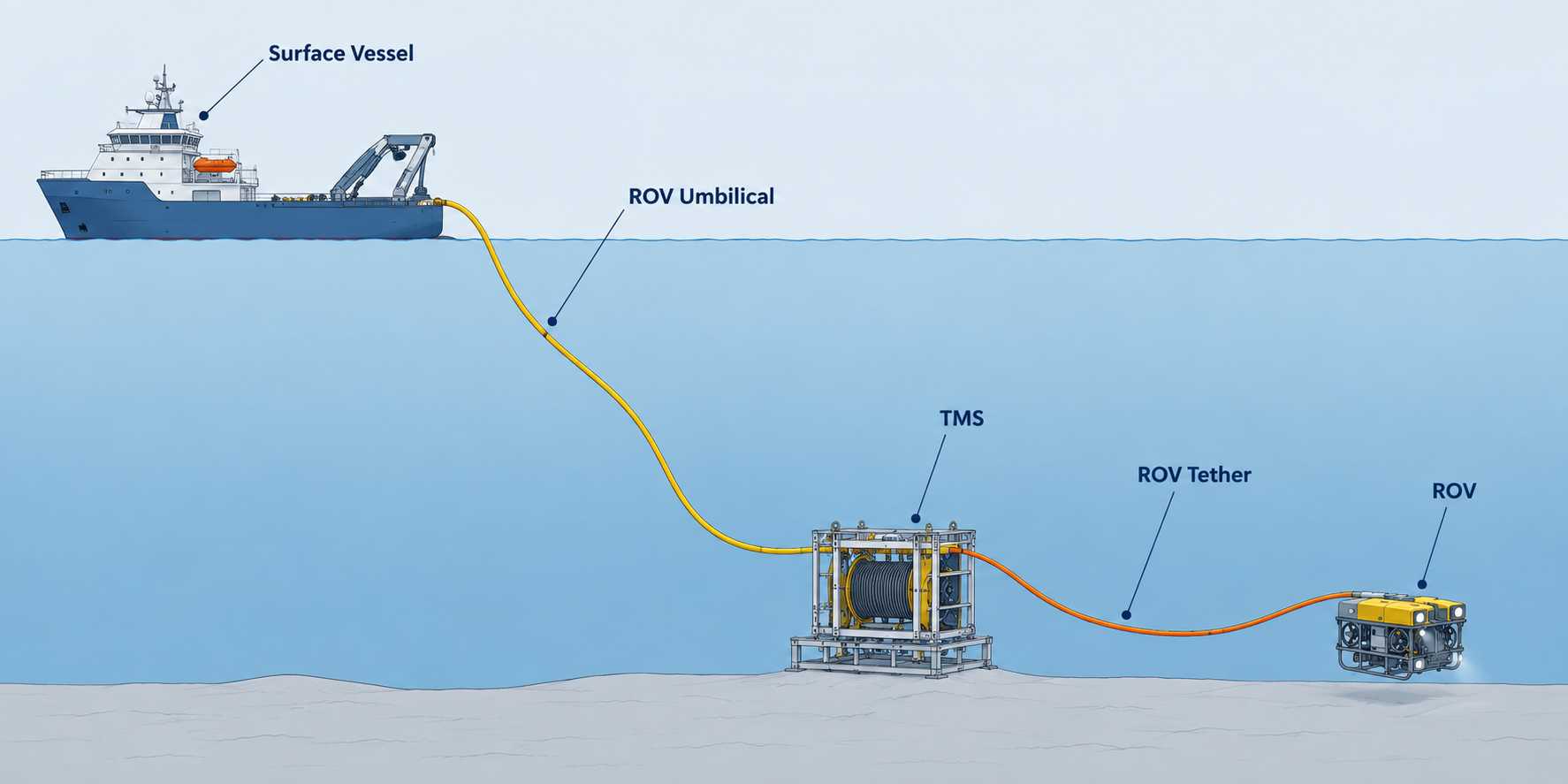
Difference between ROV umbilical and tether
Design factor | ROV Umbilical | ROV Tether |
System position | Surface system → TMS | TMS → ROV |
Main role | Main power, data and control connection | ROV power, data and control |
Typical mechanical load | High | Lower |
Buoyancy | Usually negatively buoyant | Often neutral or near-neutral |
Cable diameter | Generally larger | Generally smaller |
Reinforcement | Steel armor / high-strength elements | Kevlar, aramid or similar reinforcement |
Flexibility | Designed around deployment/recovery | Designed around continuous ROV movement |
Typical design priority | Strength, depth, power and communication | Flexibility, buoyancy and maneuverability |
What Is an ROV Umbilical Cable?
An ROV umbilical cable is the main subsea cable connecting the surface vessel, winch or control system to the ROV's Tether Management System (TMS).
Because an ROV umbilical can operate at significant water depths and may be deployed and recovered repeatedly, its design must consider tensile load, bending, pressure, water penetration, abrasion and long-term mechanical fatigue.
For work-class ROV systems, the ROV umbilical may also incorporate steel armor or other high-strength reinforcement to withstand deployment loads.
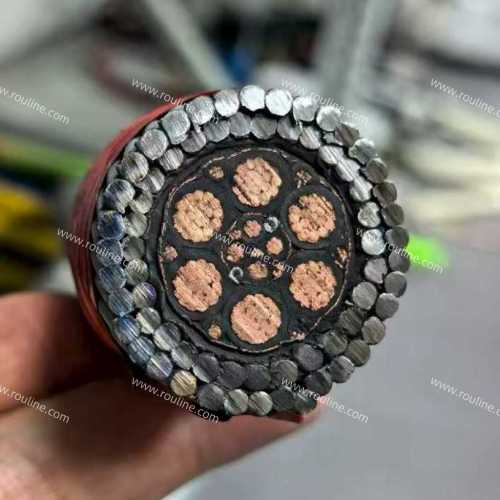
A Typical ROV Umbilical Cable with Armoured Construction by RouLine
What Is an ROV Tether?
An ROV tether cable normally connects the TMS to the ROV.
Unlike the main ROV umbilical, the tether needs to follow the movement of the ROV and therefore places greater emphasis on flexibility, low drag and controlled buoyancy.
For many ROV systems, the tether is designed for neutral or near-neutral buoyancy, allowing the ROV to maneuver without carrying excessive cable weight.
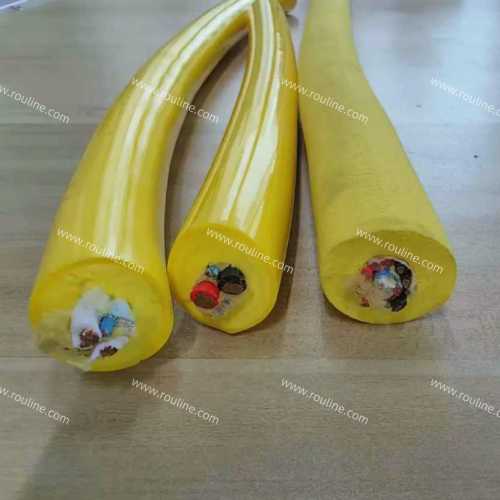
A Selection Buoyancy ROV Tether Cables by RouLine
How Does the TMS Separate the ROV Umbilical from the Tether?
In a typical work-class ROV system, the Tether Management System (TMS) separates the main umbilical from the ROV tether in terms of system function.
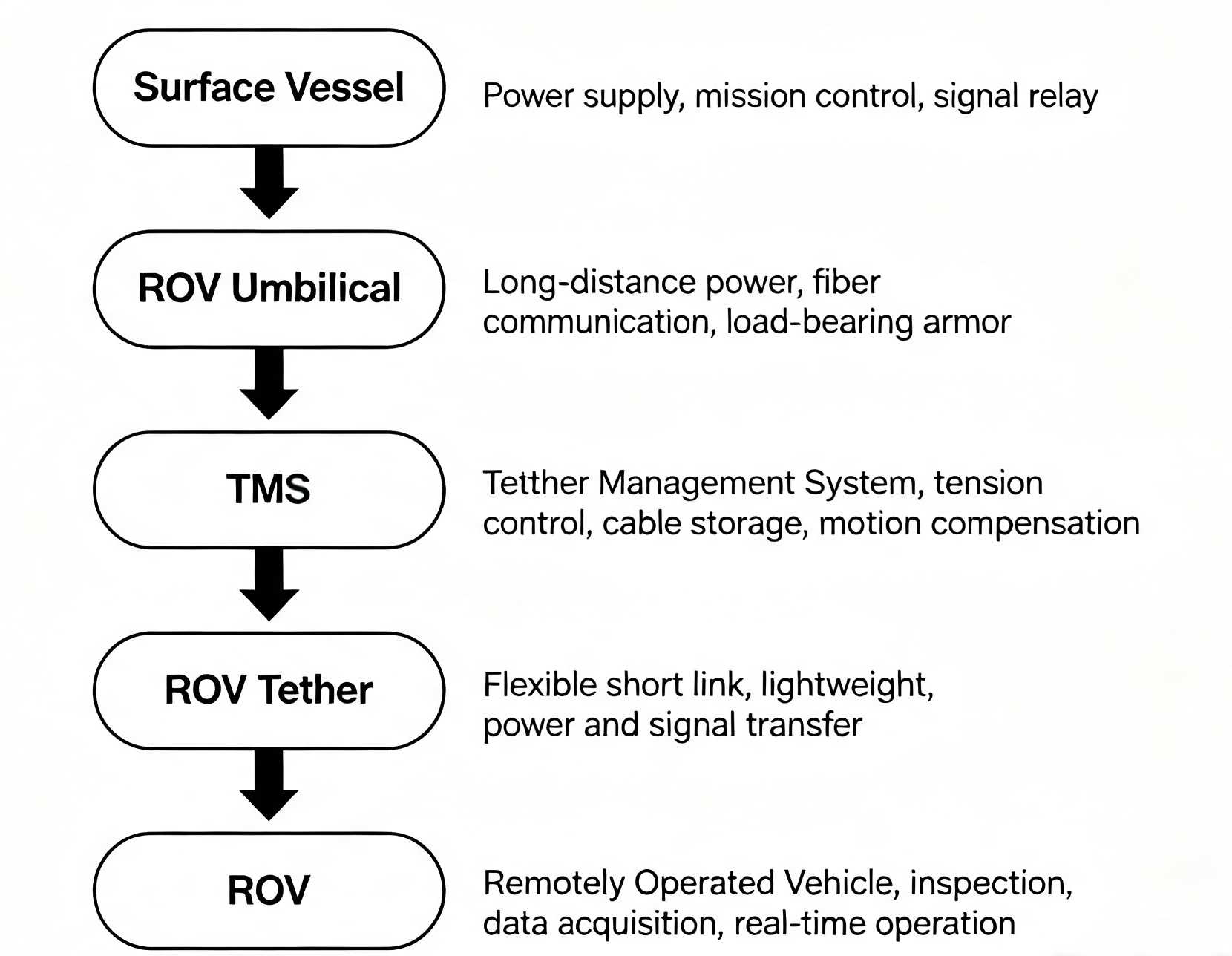
The umbilical connects the surface system to the TMS and typically carries the main power, communication and control functions, while the tether connects the TMS to the ROV and is designed to accommodate the vehicle's movement.
The TMS manages the tether and helps isolate the ROV from the movement and mechanical loads associated with the main umbilical.
However, not every ROV system uses a separate TMS. Small ROVs may use a single cable directly between the surface control system and the vehicle. In these systems, the terms tether and umbilical may be used differently depending on the manufacturer and system architecture.
How Does ROV Umbilical Construction Differ from ROV Tether Construction?
ROV Umbilical Construction
A work-class ROV umbilical may combine several functional elements within one cable, including:
Power conductors
Fiber optic units
Communication elements
Hydraulic hoses
Strength members
Steel armor
Water-blocking components
Protective outer jacket
The ROV Umbilical Cable Construction depends strongly on operating depth, required tensile strength, power transmission, communication requirements and deployment method.
For example, an umbilical used with a deepwater work-class ROV may require significantly greater mechanical strength than one used for a small observation ROV.
ROV Tether Construction
The tether generally has a simpler and more flexible construction.
Its design may combine power and communication conductors with:
Shielding
Fiber optics
Kevlar/aramid reinforcement
Buoyancy elements
Flexible jackets
The objective is to provide sufficient mechanical strength without making the tether unnecessarily heavy or stiff.
This is particularly important when the ROV needs to maneuver around subsea structures, pipelines or inspection targets.
Why Are the Buoyancy Requirements Different?
Buoyancy is one of the most important differences between an umbilical and a tether.
A main ROV umbilical is normally designed with negative buoyancy, allowing it to remain deployed below the vessel and carry its own weight and mechanical loads.
The tether, however, is often designed to be neutral or close to neutral in water. This reduces the force acting on the ROV and makes maneuvering easier. Therefore, buoyancy should be designed as part of the complete ROV cable system, rather than selected independently.
Can One Cable Be Both an Umbilical and a Tether?
In some small ROV systems, there may be no separate TMS. A single cable may run directly from the surface control system to the ROV.
In this situation, manufacturers or operators may use the terms rov umbilical, rov tether or tether cable differently. Therefore, terminology should not be determined only by cable diameter. For systems without a TMS, the cable architecture and application should be reviewed before determining the appropriate terminology.
ROV Umbilical vs ROV Tether: Which Cable Do You Need?
The easiest way to distinguish them is to look at the ROV system architecture:
Surface Vessel → ROV Umbilical → TMS → ROV Tether → ROV
For a work-class ROV, the ROV umbilical normally requires greater attention to tensile strength, power transmission, fiber integration, deployment loads and operating depth.
The tether normally requires greater attention to flexibility, buoyancy, bending, abrasion resistance and ROV maneuverability. When a TMS is not used, the terminology can vary and the complete cable application should be evaluated.
Conclusion
ROV umbilical and ROV tether cables perform different jobs within an underwater ROV system.
The ROV umbilical is generally the main connection between the surface system and TMS, where high power, communication capacity, tensile strength and deployment performance are critical.
The ROV tether connects the TMS to the ROV and is typically optimized for flexibility, buoyancy and maneuverability.
For Custom ROV Cable Design, the starting point should therefore be the system architecture, mechanical load, power and communication requirements, operating depth and environmental conditions.
This approach helps determine whether the application requires an ROV umbilical, ROV tether, or a customized cable solution combining multiple functions.

Post time:2026-09-15
