

Which Crane Cable Do You Need:
Reeling, Festoon or Spreader Cable?
Reeling, festoon and spreader cables are all used in crane systems, but they are designed for different types of movement and mechanical loading.
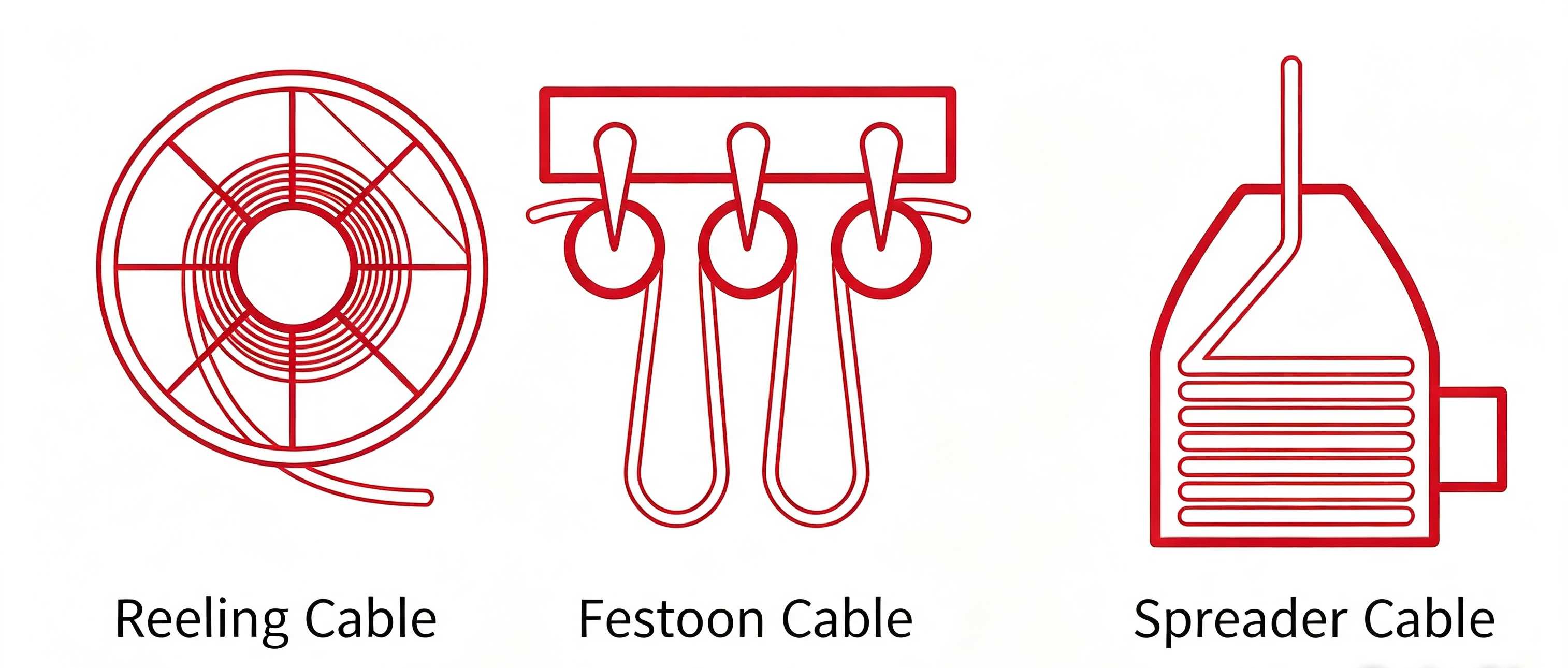
A reeling cable is wound and unwound from a drum. A festoon cable travels through suspended loops as the crane moves. A spreader cable may hang vertically between the crane and a moving spreader, where the cable's own weight and tensile load become important design factors.
For port cranes and other demanding lifting equipment, choosing the cable by voltage and conductor size alone is not enough. The cable must also match the movement, bending pattern, tensile load and operating environment.
Reeling vs Festoon vs Spreader Cable: What's the Difference?
Cable Type | How It Moves | Main Mechanical Stress | Typical Applications |
Wound and unwound on a drum | Bending, torsion and tensile loads | RTG, RMG, STS and other port cranes | |
Travels in repeated suspended loops | Repeated bending and flexing | Bridge cranes, gantry cranes and festoon cable systems | |
Hangs vertically with the moving load | Tensile load, bending and self-weight | Container spreaders and lifting equipment |
The most important question is therefore:
How does the cable move during operation?
If the cable is continuously wound onto a reel, a reeling cable is normally the appropriate starting point. If it moves through a festoon system, a festoon cable should be considered. If it is suspended vertically from a crane to a spreader or other moving load, a spreader cable requires a different mechanical design.
When Do You Need a Reeling Cable?
A reeling cable is designed for applications where the cable is repeatedly collected onto and released from a motorized or spring-operated drum.
This creates a combination of repeated bending, tension and, depending on the installation, torsional stress. The cable therefore needs a construction specifically designed for dynamic reeling rather than simply a flexible fixed-installation cable.
Typical applications include:
RTG and RMG cranes
Port handling equipment
Long-travel gantry cranes
High-speed crane systems
For demanding port crane cables, the construction may include Class 5 or Class 6 flexible copper conductors, reinforced cable elements and a highly abrasion-resistant outer jacket.
An anti-torsion reeling cable can be particularly important when the cable experiences significant twisting during winding and unwinding. The drum diameter, cable outer diameter, winding arrangement and operating speed should also be considered together.
For high-speed applications, the cable should be selected according to the actual travel speed and reel design rather than relying on a generic speed rating.
When Do You Need a Festoon Cable?
A festoon cable works differently. Instead of being wound onto a drum, the cable is supported by trolleys and forms a series of loops that move along a rail or track.
The primary mechanical requirement is repeated flexing.
A properly designed festoon cable must maintain flexibility through thousands or millions of movement cycles while avoiding excessive twisting, abrasion or mechanical stress.
Festoon cable systems are commonly used on:
Overhead bridge cranes
Gantry cranes
Workshop cranes
Monorail systems
Material-handling equipment
Flat cables are often used where the festoon arrangement requires a compact and controlled cable path. Round flexible cables may also be suitable for specific systems.
For outdoor cranes, jacket selection becomes increasingly important. PUR or other suitable materials can provide improved resistance to abrasion, oil, UV exposure and weathering compared with conventional cable constructions.
Where the crane operates in a port or coastal environment, resistance to salt spray and corrosion should also be included in the specification.
When Do You Need a Spreader Cable?
A spreader cable has a different mechanical challenge from both reeling and festoon cables.
When the cable hangs vertically between a crane and a container spreader, the cable's own weight creates a continuous tensile load. The cable may also experience repeated bending as the spreader moves, lifts and lowers.
This means the cable should not be selected only according to its voltage and number of cores.
A properly engineered spreader cable may incorporate an internal aramid/Kevlar tensile member or another dedicated reinforcement system. The tensile element is designed to carry mechanical loads so that the copper conductors are not forced to support the suspended weight.
The required construction depends on:
Cable length
Vertical suspension distance
Moving load
Operating speed
Bending radius
Cable weight
Environmental conditions
For longer suspended applications, the supporting system and cable management arrangement should be considered together with the cable construction.
How Does the Crane Environment Affect Cable Selection?
Mechanical movement is only one part of the selection process. Many port crane cables operate outdoors and are exposed to significantly harsher conditions than indoor industrial cables.
Salt Spray and Corrosion
Crane systems located near seawater may be exposed to continuous salt spray and humidity.
For these applications, the cable design may use corrosion-resistant conductors or shielding, suitable jacket materials and appropriate sealing or protection. Tinned copper conductors can be considered where additional corrosion resistance is required.
UV and Weather Exposure
Outdoor crane cables are exposed to sunlight and changing weather conditions. The outer jacket should therefore be selected for the expected UV and weathering conditions.
Oil and Abrasion
Cables may come into contact with hydraulic oil, lubricants or other industrial fluids. At the same time, movement against cable guides, drums or trolleys can cause mechanical abrasion.
For demanding applications, a PUR-based jacket can provide a useful combination of flexibility, abrasion resistance and resistance to oils and outdoor exposure.
Low Temperature
Cranes operating in northern ports or cold environments may require a low-temperature cable construction.
The important factor is not simply the stated temperature range. The cable must retain sufficient flexibility for the actual dynamic movement at low temperature.
Reeling vs Festoon vs Spreader Cable: Key Selection Factors
Before selecting a cable, evaluate the mechanical system first.
Selection Factor | Reeling Cable | Spreader Cable |
Main movement | Winding / unwinding | Vertical suspension |
Bending | Continuous | Repeated |
Torsion | Important | Application dependent |
Tensile reinforcement | Often required | Critical for suspended loads |
Flexible conductor | Class 5/6 | Class 5/6 |
Outdoor protection | UV, oil, abrasion | UV, oil, abrasion |
Salt-spray resistance | Often important | Important outdoors |
VFD shielding | Application dependent | Application dependent |
The exact bending radius, tensile rating and dynamic life should always be based on the cable manufacturer's tested construction and the actual crane system.
Common Crane Cable Selection Mistakes
Using a fixed cable for dynamic movement
A standard fixed-installation cable may have the correct voltage and conductor size but lack the mechanical construction required for continuous movement.
Using a festoon cable for reeling
A cable designed for repeated festoon flexing is not automatically suitable for drum reeling. Reeling applications can introduce additional torsional and winding stresses.
Selecting a spreader cable without considering tensile load
For vertically suspended cables, the cable's own weight can become significant. The mechanical load should be carried by a dedicated reinforcement system where required.
Ignoring the installation environment
A cable specification that works indoors may not be suitable for a coastal port exposed to salt spray, UV, oil and abrasion.
Choosing only by cable size
Two cables with the same number of cores and conductor cross-section can have very different dynamic performance because of differences in conductor construction, reinforcement, shielding and jacket design.
What Information Should You Provide When Ordering a Crane Cable?
For a custom reeling cable, festoon cable or spreader cable, the following information helps determine the appropriate construction:
Mechanical requirements
Crane type
Travel distance
Cable length
Operating speed
Minimum bending radius
Vertical suspension length
Tensile load
Reel or festoon system dimensions
Electrical requirements
Rated voltage
Conductor size
Number of cores
Grounding
Shielding
VFD requirements
Data, Ethernet or fiber optic requirements
Environmental requirements
Operating temperature
UV exposure
Salt spray
Oil exposure
Abrasion
Flame-retardant requirements
Which Crane Cable Do You Need?
The selection can be simplified to three questions:
Does the cable wind onto a drum?
→ Choose a Reeling Cable.
Does the cable travel in suspended loops?
→ Choose a Festoon Cable.
Does the cable hang vertically with a moving spreader or load?
→ Choose a Spreader Cable.
For demanding crane applications, however, the cable type is only the starting point. The final construction should be matched to the actual movement, mechanical loading, electrical requirements and environmental conditions.
The right crane cable is selected by how it moves, how it is loaded and where it operates, not simply by its voltage and conductor size.

Post time:2026-09-15
