

What Is an Armoured ROV Cable?
Structure, Materials and Engineering Design
Introduction to ROV Cables
ROV cables are specialized subsea cables designed to transmit power, control signals, and data between surface systems and underwater equipment. They are widely used in offshore engineering, underwater inspection, and deep-sea mining where reliability is critical.
Among different configurations, the armoured ROV cable is one of the most robust designs, engineered to withstand high mechanical stress, pressure, and continuous dynamic movement in subsea environments.
This makes it a preferred solution for harsh subsea environments, including drilling support and ROV survey operations.
What Is an Armoured ROV Cable?
An armoured ROV cable is a reinforced type of ROV cable that incorporates steel wire or composite armouring layers to enhance mechanical strength. This construction protects the internal conductors and fiber optics from tension, bending, abrasion, and external impact.
Compared with standard marine cables, armoured designs significantly improve durability in demanding subsea applications.
Difference Between Standard and Armoured ROV Cable
Standard ROV cables focus primarily on signal and power transmission, while armoured versions prioritize mechanical strength and durability.
Armoured ROV cable systems are therefore preferred in:
Deep-sea exploration
Offshore construction support
Subsea Cable Armouring Construction and Performance
The armouring layer is usually made of high-tensile steel wires arranged in balanced layers to prevent torque and deformation. In some designs, polymer coatings are applied to improve corrosion resistance in seawater environments.
This structure enables the cable to perform reliably under:
High tension loads
Continuous flexing
Deep-sea pressure
Abrasive seabed conditions
The cable's tensile strength can be provided by either a single layer or double layers of steel wire armouring.
A Single Layer design offers a simpler structure and is suitable for lower-load applications.
A Double Layer design provides higher overall tensile capacity and superior mechanical performance, with total tensile strength selectable from 20 to 80 tonnes, tailored to the specific weight and operational demands of the mining tool.
Torque-balanced Double-layer Armor: Opposite lay directions with matched wire diameters, lay angles, and pre-tensions ensure that under rated tension, inner and outer layer moments are equal and opposite, approaching net zero torque. This prevents rotation under tension and relative slip between layers. Tensile strength: 20 to 80 tonnes, selectable by mining tool weight.
Anti-torsion Stranding: Four measures during core stranding, optimized lay angles for uniform stress distribution, fillers between groups to prevent radial displacement, twisted pairs for self-cancellation of torsional stress, and individual layer binding to limit relative rotation. This isolates internal fibers and conductors from armor torsion.
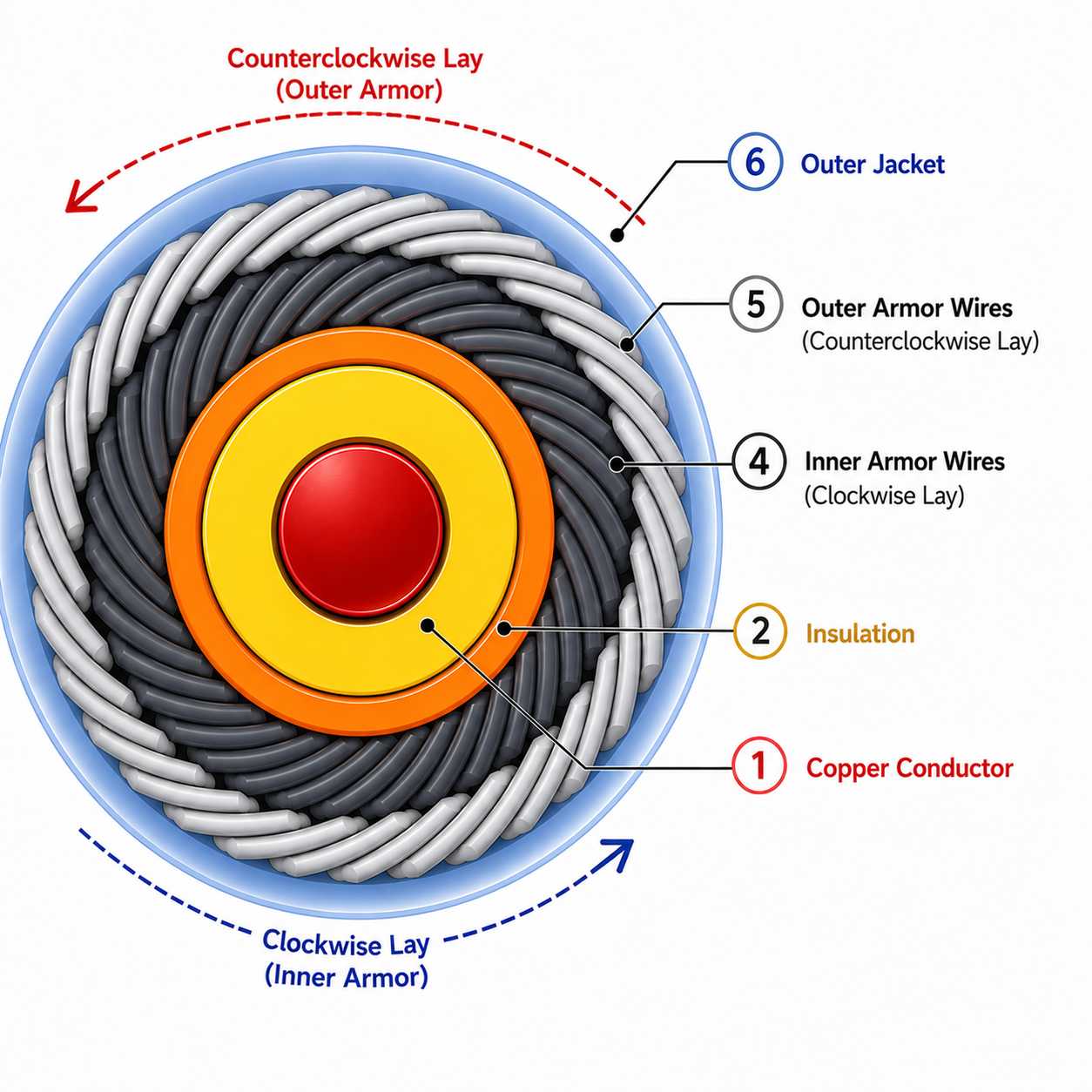
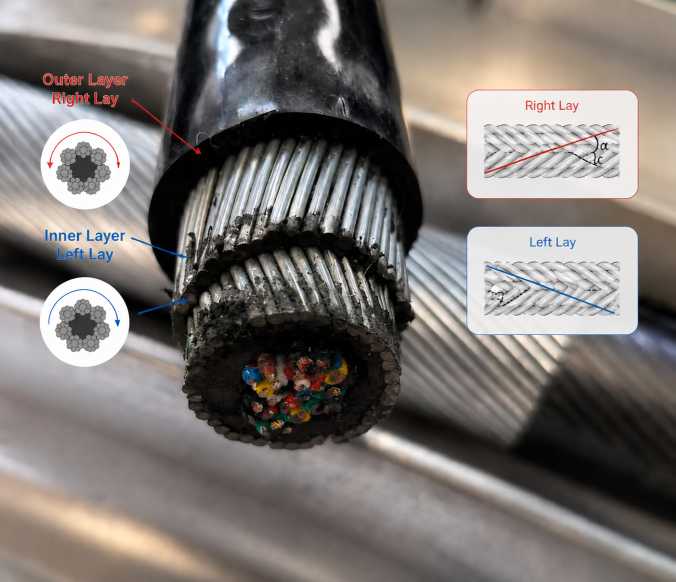
A sample of armoured subsea rov cable designed and produced by RouLine
Learn more about our product details: ROV Cable with Armoured Construction
Key Engineering Structure
An armoured ROV cable typically consists of:
Conductors for Power Transmission
The copper conductors in an ROV cable employ a stranded configuration to minimize ohmic losses and the skin effect over lengths that can extend for several kilometers. Their cross-sectional area is precisely calculated based on the vehicle's peak power demand and allowable voltage drop, ensuring stable power delivery even during aggressive dynamic operations.
Insulation Layers for Electrical Stability
For subsea ROV cables, the insulation layer is typically made of XLPE or EPR, providing high dielectric strength, low leakage, and partial discharge resistance in deep-sea environments, while advanced ROV tether designs add a semi-conductive screen over the insulation to homogenize the electric field and avoid stress-induced premature failure.
Fiber Optic Cores for High-Speed Data Communication
Integrated alongside the power conductors are single-mode or multi-mode optical fibers, which serve as the ROV’s neural network. The fibers are typically housed within loose tubes or tight-buffered structures, protected from hydrogen ingress and micro-bending losses, in deep-sea environments. Fiber count: 6 to 24 single-mode.
Tensile Members for Load Bearing
Subsea cable normally employs high-strength synthetic tensile members, such as aramid fibers or HMPE, arranged as a central core or helical wrap, which provide exceptional axial stiffness and load capacity against self-weight, drag, and recovery loads, while offering low submerged weight and the flexibility required for TMS bending operations.
Steel Wire Armouring for Mechanical Protection
The outer layer of an armoured ROV cable features galvanized or stainless steel wire armouring, which provides mechanical protection against abrasion. A tighter lay enhances flexibility for dynamic tether applications, whereas a steeper angle maximizes tensile strength for static deployment, with some designs additionally using the armouring as a sacrificial anode or to improve bending stiffness against kinking.
This layered structure ensures stable performance in both static and dynamic ROV tether systems.
Armoured ROV cables represent a critical engineering solution for subsea operations requiring both electrical performance and mechanical resilience. Their layered design ensures reliable operation in some of the harshest underwater environments, making them widely used in offshore and subsea cable systems.
Need a Custom ROV Cable Solution?
We provide engineered ROV cable systems designed for offshore energy, subsea robotics, and deep-sea exploration applications. Contact our engineering team for technical consultation, datasheets, or customized cable design support.
Post time:2026-06-21
