

Why Jacket Material Selection Matters
in Subsea Cable Design
In subsea applications, the outer jacket is not only a protective layer but also a critical part of the overall cable design. The right subsea cable jacket material directly affects cable durability, flexibility, mechanical protection, and long-term performance in underwater environments.
Unlike standard industrial cables, subsea cables are exposed to continuous challenges, including seawater immersion, hydrostatic pressure, abrasion, marine growth, temperature variation, and mechanical loading during installation or operation.
For dynamic applications such as ROV systems, the cable may experience repeated bending, pulling, and movement. In these cases, flexibility and abrasion resistance become key selection factors. For static subsea installations, long-term water resistance and material stability may be more important.
Therefore, selecting the right subsea cable materials requires evaluating the complete operating environment rather than choosing a jacket material based only on basic specifications.

PUR Jacket for Subsea Cables:
Flexible Performance for Dynamic Applications
Polyurethane (PUR) is one of the most widely used jacket materials for dynamic underwater cable applications because of its excellent mechanical performance.
A PUR subsea cable is typically selected when the cable needs to withstand frequent movement, bending cycles, and mechanical stress.
Key advantages of PUR jacket materials include:
High flexibility for repeated bending
Excellent abrasion resistance against external wear
Good resistance to oil, seawater, and harsh environments
Strong mechanical durability for dynamic applications
For ROV operations, the cable is often subjected to continuous movement caused by vessel motion, underwater currents, and vehicle operation. In these applications, a flexible PUR subsea cable structure can help reduce mechanical stress and improve operational reliability.
PE Jacket for Subsea Cables:
Lightweight and Long-Term Water Resistance
Polyethylene (PE) is another commonly used material in underwater cable materials because of its excellent water resistance and chemical stability.
Compared with PUR, PE generally provides:
Lower water absorption
Excellent resistance to seawater
Good chemical resistance
Lightweight cable construction
Stable long-term performance
However, PE has lower flexibility compared with PUR. Therefore, it is usually not the preferred option for applications involving frequent bending, dynamic movement, or repeated mechanical loading.
TPU Jacket for Subsea Cables:
High Durability and Flexibility for Dynamic Underwater Applications
Thermoplastic Polyurethane (TPU) is a high-performance jacket material widely used in dynamic underwater cable applications where flexibility, abrasion resistance, and mechanical durability are critical. Compared with conventional jacket materials, TPU provides excellent elastic recovery and mechanical strength, helping maintain cable reliability during long-term operation.
Key advantages of TPU jacket materials include:
Excellent abrasion resistance against external wear
High flexibility for repeated bending and dynamic movement
Strong tear resistance and mechanical durability
Good resistance to seawater, oil, and harsh marine environments
Stable performance under frequent handling and operational stress
When designing a dynamic subsea cable, TPU jacket selection should be considered together with reinforcement structure, tensile requirements, buoyancy characteristics, and transmission requirements to achieve reliable long-term performance.
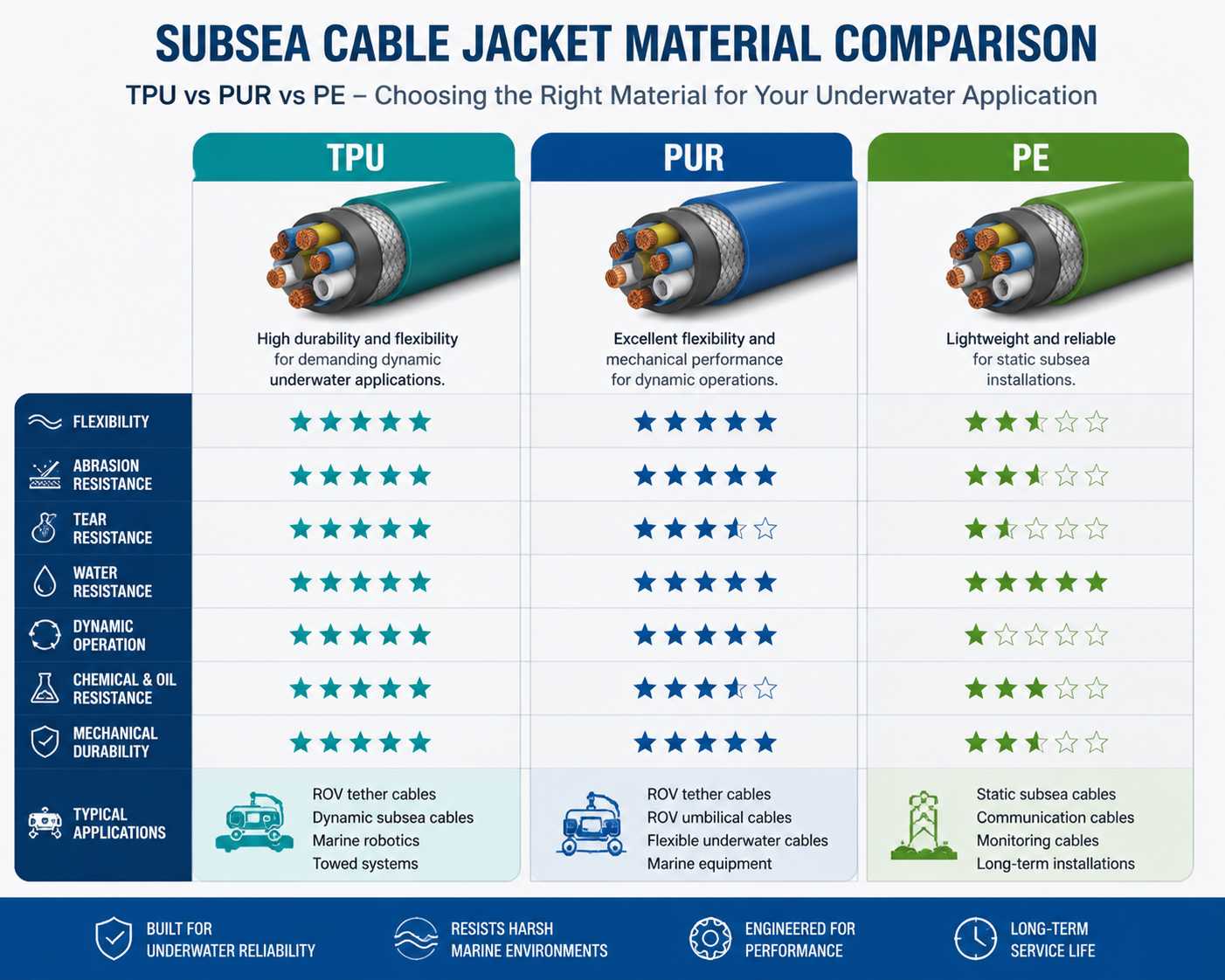
PUR vs PE vs TPU: Subsea Cable Material Comparison
Different subsea applications require different cable characteristics. The following comparison highlights the typical differences between major jacket materials.
Performance Factor | TPU | PUR | PE |
Flexibility | Excellent | Excellent | Medium |
Abrasion Resistance | Excellent | Excellent | Good |
Tear Resistance | Excellent | Very Good | Medium |
Water Resistance | Excellent | Excellent | Excellent |
Dynamic Operation | Excellent | Excellent | Limited |
Mechanical Durability | Excellent | Excellent | Good |
Oil & Chemical Resistance | Excellent | Good | Good |
Temperature Performance | Good | Good | Good |
Typical Applications | ROV tether, dynamic subsea cables, marine robotics | ROV tether, umbilical cables, flexible underwater cables | Static subsea cables, communication and monitoring cables |
There is no single “best” material for all subsea cable applications. The optimal choice depends on operating depth, mechanical loading, movement requirements, and electrical performance requirements.
How to Select the Right Jacket Material for Subsea Cable Applications
Selecting suitable subsea cable materials requires understanding the actual working conditions of the cable.
Dynamic or Static Operation
The first consideration is whether the cable will experience continuous movement.
Dynamic applications. PE-based solutions are commonly considered for these applications.
Mechanical Loading and Protection Requirements
Subsea cables may experience different mechanical forces depending on deployment methods. The jacket material must work together with the reinforcement structure to achieve the required mechanical performance.
Electrical and Communication Requirements
Modern subsea systems often combine multiple functions, For example, an ROV tether cable may integrate power conductors and fiber optic channels inside a flexible jacket structure.
The final material selection depends on the complete cable configuration, including conductor size, shielding design, insulation system, and mechanical reinforcement.
Customized Subsea Cable Solutions with Optimized Jacket Materials
Every subsea project has different requirements for operating depth, movement conditions, mechanical loading, and transmission performance.
For dynamic ROV applications, a flexible PUR-based design may provide better operational performance. For fixed underwater systems, PE or TPU-based solutions may offer advantages depending on electrical and environmental requirements.
Choosing the correct subsea cable materials at the design stage helps improve reliability, reduce maintenance requirements, and extend cable service life in harsh marine environments.
Need a customized subsea cable solution? Contact our engineering team to discuss your application requirements, including operating depth, mechanical loading, power transmission, and communication needs.
FAQ
What is the best jacket material for subsea cables?
The best jacket material depends on the application. PUR is commonly used for dynamic subsea cables requiring flexibility and abrasion resistance, while PE is often selected for static underwater installations. TPU is typically used where high electrical performance is required.
Is PUR suitable for ROV tether cables?
Yes. PUR is widely used for ROV tether cables because of its excellent flexibility, abrasion resistance, and mechanical durability under repeated movement.
What is the difference between PE and PUR subsea cables?
PUR provides better flexibility and abrasion resistance, making it suitable for dynamic applications. PE provides excellent water resistance and stability, making it more suitable for static subsea installations.
Post time:2026-08-06
