

Reinforced ROV Umbilical Cable:
Tensile Strength, Material and Applications
The Role of Reinforced ROV Umbilical Cable in Deep Water Operations
As remotely operated vehicles (ROVs) continue to operate in deeper and more challenging underwater environments, the reliability of the cable system connecting the surface vessel and the vehicle has become increasingly important.
A Reinforced ROV Umbilical Cable is a highly engineered ROV umbilical cable designed to combine electrical transmission, signal communication, and mechanical load carrying capability within a single subsea system.
With increasing operating depths, cable weight and tensile loading become major engineering challenges. A longer cable means greater suspended weight, higher tension, and increased fatigue caused by vessel movement, currents, and repeated winch operations. Therefore, the design of a deep water ROV cable requires a balance between:
Tensile strength
Cable weight
Flexibility
Fatigue resistance
Long-term subsea reliability
Designed and manufactured by RouLine, our steel wire Armored ROV Umbilical Cable is developed for deep-water applications requiring high tensile strength, mechanical durability, and customized power, signal, and fiber optic integration.
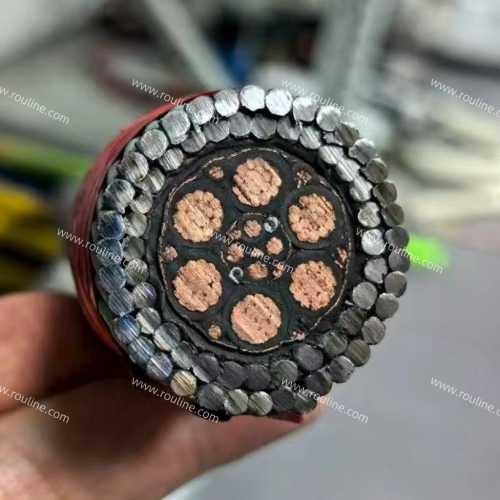
→Explore the steel wire Reinforced ROV Umbilical Cable manufactured by RouLine
Construction of Reinforced ROV Umbilical Cable
A reinforced ROV umbilical cable is not a simple power cable. It is a multi-functional subsea system consisting of several engineered layers.
The typical structure includes:
1. Functional cable core
2. Internal protection layers
3. Reinforcement system
4. Outer protective jacket
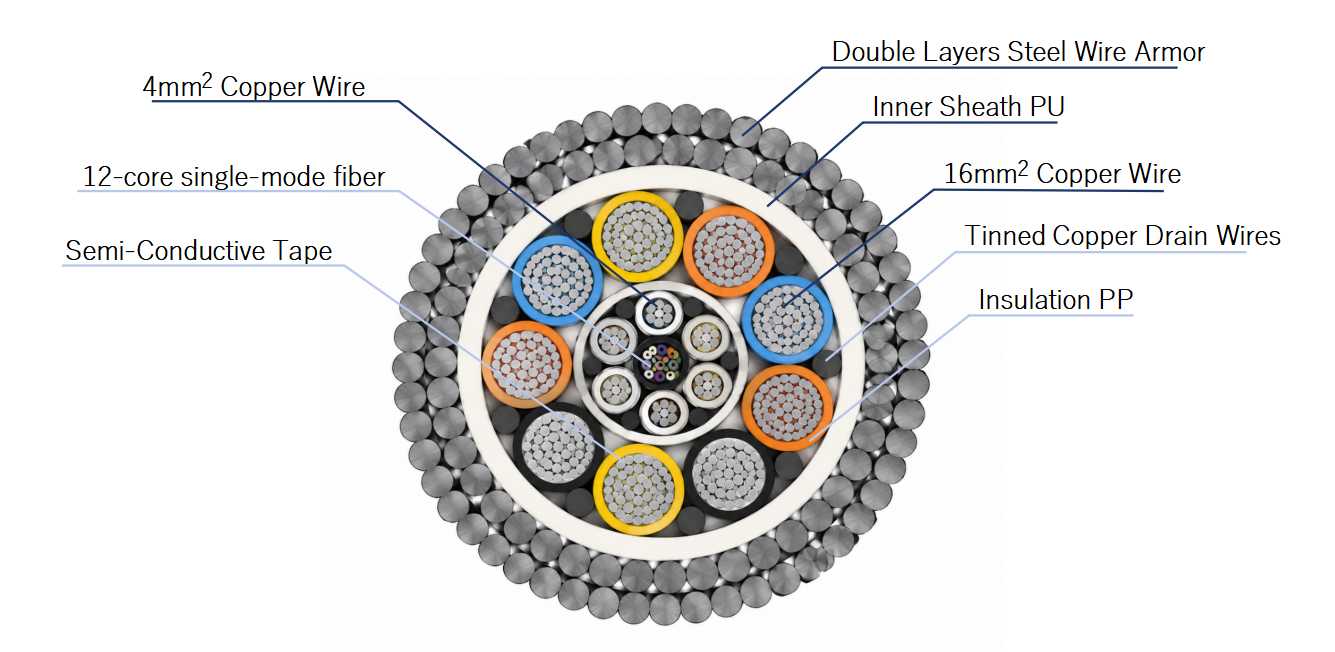
A typical steel wire armored rov umbilical cable manufactured by RouLine
Reinforcement System: The Mechanical Backbone of ROV Umbilical Cable
The reinforcement system determines the mechanical performance of a reinforced ROV umbilical cable. As water depth increases, cable self-weight becomes a major factor. A stronger cable is not always the optimal solution because additional reinforcement also increases cable weight. The objective is to achieve the highest mechanical performance with the lowest possible underwater weight.
Engineering Design Chain
The mechanical capability of a reinforced ROV umbilical cable is determined through a complete engineering chain:
Application Requirements
↓
Cable Structural Design
↓
Reinforcement System Selection
↓
Tensile Strength & Weight Optimization
↓
Deployment Capability
↓
ROV Mission Performance
Each design decision, from reinforcement material selection to cable structure optimization, directly influences the allowable operating depth and overall ROV system capability.
Key Mechanical Parameters
The ROV umbilical cable tensile strength determines how deep and how safely the system can operate.
Parameter | Description |
Minimum Breaking Load (MBL) | Maximum tensile load before cable failure |
Working Load | Normal operating tension range |
Safety Factor | Protection margin between working load and MBL |
Bending Radius | Determines fatigue performance and equipment compatibility |
Reinforcement Material Selection
Steel Wire Reinforced ROV Umbilical Cable
Steel wire reinforcement remains one of the most widely used solutions for demanding subsea operations. A steel wire ROV umbilical cable typically uses:
Galvanized steel wire
Stainless steel wire
Single or double-layer armor structures
A steel armored ROV cable is especially suitable for applications:
Offshore ROV operations
Heavy-duty inspection systems
Deep-water intervention projects
Lightweight Reinforcement: Aramid and Hybrid Structures
For ultra-deep-water applications, reducing cable weight becomes increasingly important. Compared with steel wire reinforcement, fiber-based reinforcement reduces suspended cable weight, allowing more payload capacity for the ROV system.
However, fiber reinforcement requires careful design because it has lower resistance to Compression, External crushing and Abrasion between fibers.
Hybrid reinforcement structures combine different materials to achieve a balance between Steel mechanical protection and Fiber lightweight advantages.
This approach is becoming increasingly important for future deep-water ROV applications.
Applications of Reinforced ROV Umbilical Cable
Different applications require different cable structures.
Application | Main Requirement | Recommended Cable Design |
Main Lift Umbilical | High tensile load | Steel wire reinforced |
ROV Tether Cable | Flexibility and low weight | Lightweight reinforced |
Offshore Inspection | Balanced performance | Customized structure |
Deep Sea Mining | Strength and protection | Heavy-duty reinforced cable |
Subsea Research | Data transmission reliability | Hybrid electrical/optical design |
Main Lift Umbilical Cable
Main lift umbilical cables connect the vessel, LARS, and Tether Management System. These cables experience:
High tensile loads
Long deployment distances
Dynamic vessel movement
For these applications, steel wire reinforced designs are commonly selected due to their excellent mechanical strength.
ROV Tether Cable
The tether cable connects the TMS and the ROV.
Compared with main lift cables, tether cables require:
Higher flexibility
Lower weight
Better maneuverability
Lightweight reinforced structures are often preferred because they reduce drag and improve ROV movement.
Deep Sea Mining ROV Cable
Deep sea mining represents one of the most demanding applications for reinforced subsea cables. A deep sea mining ROV cable must withstand:
Long-term underwater loading
Mechanical impact
Abrasion risks
High tensile requirements
The cable design may require:
Steel wire reinforcement
Additional protective layers
Integrated power and communication systems
Reinforcement Selection Guide for ROV Umbilical Cable
Application Requirement | Recommended Reinforcement Design | Main Reason |
High suspended load | Steel wire armor | Provides high tensile strength and load-carrying capability |
Long vertical deployment | Steel reinforced cable | Better performance under continuous static tension |
High crushing or impact risk | Steel armor | Excellent compression resistance and mechanical protection |
Offshore heavy-duty operation | Steel armored ROV cable | Suitable for demanding subsea environments requiring durability |
Ultra-deep water operation | Lightweight reinforcement | Reduces cable self-weight and increases payload capability |
Limited ROV payload capacity | Aramid reinforced cable | High strength-to-weight ratio reduces underwater weight |
High maneuverability requirement | Flexible reinforced cable | Improved flexibility for dynamic ROV movement |
Reduced underwater weight requirement | Fiber-based reinforcement | Minimizes suspended weight for deep-water applications |
Conclusion
A Reinforced ROV Umbilical Cable is a critical component for modern subsea operations, combining power transmission, communication capability, and mechanical reinforcement in one integrated system.
Steel wire reinforcement provides excellent tensile strength and mechanical protection for demanding applications, while lightweight fiber and hybrid reinforcement structures provide new solutions for deeper and more weight-sensitive operations. From offshore inspection to deep-water exploration and deep sea mining ROV cable applications, the optimal cable design depends on operating depth, mechanical loading, flexibility requirements, and system integration needs.
Custom ROV umbilical cable solutions require advanced manufacturing capability to integrate conductors, optical fibers, reinforcement layers, and protective materials according to project-specific requirements.

Post time:2026-09-28
