

How to Select the Right Industrial Cable for Harsh Environments
A practical engineering guide to selecting industrial cables based on operating conditions, mechanical stress, and environmental challenges.
Introduction
Industrial cable failures are often caused by mechanical stress, harsh environments, or incorrect cable selection rather than electrical performance alone. A cable designed for one application may fail quickly when exposed to continuous flexing, abrasion, chemicals, seawater, or extreme temperatures.
Selecting the right industrial cable starts with understanding the operating environment—not simply choosing a cable specification. This guide explains the key factors engineers should evaluate before selecting an industrial cable for demanding applications.
Why Proper Cable Selection Matters
Choosing the wrong industrial cable can lead to premature failure, unplanned downtime, increased maintenance costs, and unnecessary equipment replacement. In critical industries such as marine, mining, automation, and material handling, cable reliability directly affects productivity and operational safety.
Every industrial application presents a unique combination of movement, environmental exposure, electrical requirements, and mechanical stress. Understanding these conditions is the first step toward selecting an industrial cable that delivers reliable long-term performance.
Step 1. Understand the Operating Environment
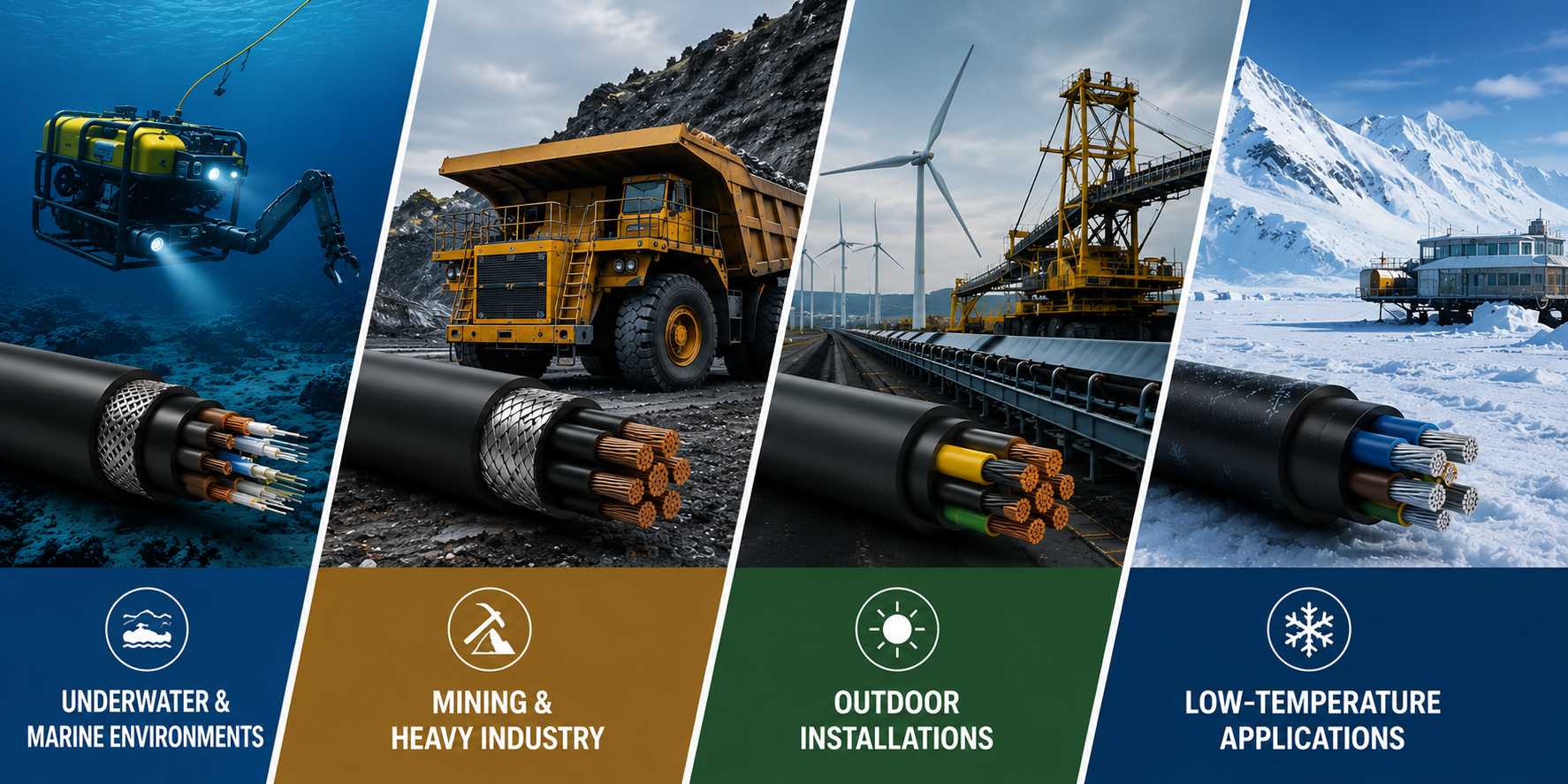
The operating environment is the starting point for every industrial cable selection. A cable that performs well in one application may fail prematurely in another if environmental conditions are not fully considered. Before selecting an industrial cable, evaluate the following factors:
Underwater & Marine Environments
Applications such as ROVs, sonar systems, and subsea equipment require subsea cables with excellent water resistance, corrosion protection, pressure resistance, and long-term reliability.
Mining & Heavy Industry
Mining equipment operates under severe mechanical stress. Cables must withstand abrasion, impact, oil, moisture, and frequent movement while maintaining stable performance.
Outdoor Installations
Industrial cables used outdoors should resist UV exposure, rain, dust, and seasonal temperature changes to ensure long service life.
Low-Temperature Applications
For cold storage, polar regions, and winter outdoor equipment, a low temperature cable should remain flexible without cracking or losing mechanical strength.
Step 2. Identify Critical Performance Requirements
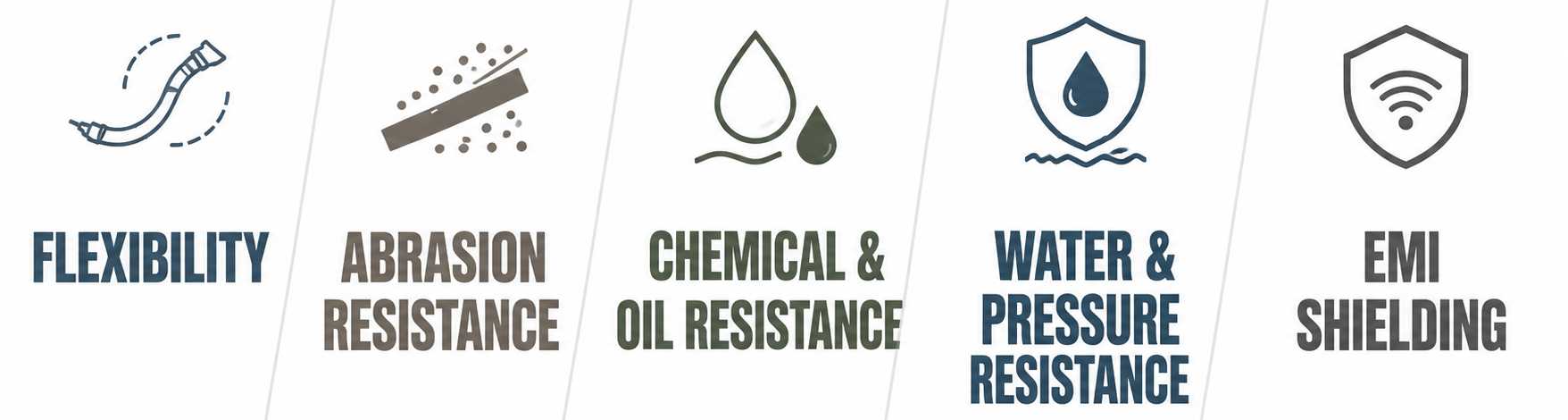
After understanding the environment, the next step is identifying the performance characteristics required by the application.
Flexibility
Continuous bending or repetitive motion requires a flexible industrial cable specifically designed for dynamic applications such as cable reels, robotics, and elevator systems.
Abrasion Resistance
Applications involving dragging, friction, or rough surfaces should use an abrasion resistant cable with durable jacket materials to minimize wear.
Chemical & Oil Resistance
Industrial plants, mining equipment, and offshore machinery often expose cables to oils, fuels, cleaning agents, or chemicals. Selecting suitable jacket materials helps extend service life.
Water & Pressure Resistance
Marine and underwater systems require cable constructions that prevent water ingress while maintaining electrical performance under pressure.
EMI Shielding
Where sensitive control or communication signals are present, shielding minimizes electromagnetic interference and improves signal stability.
Step 3. Consider Mechanical Movement
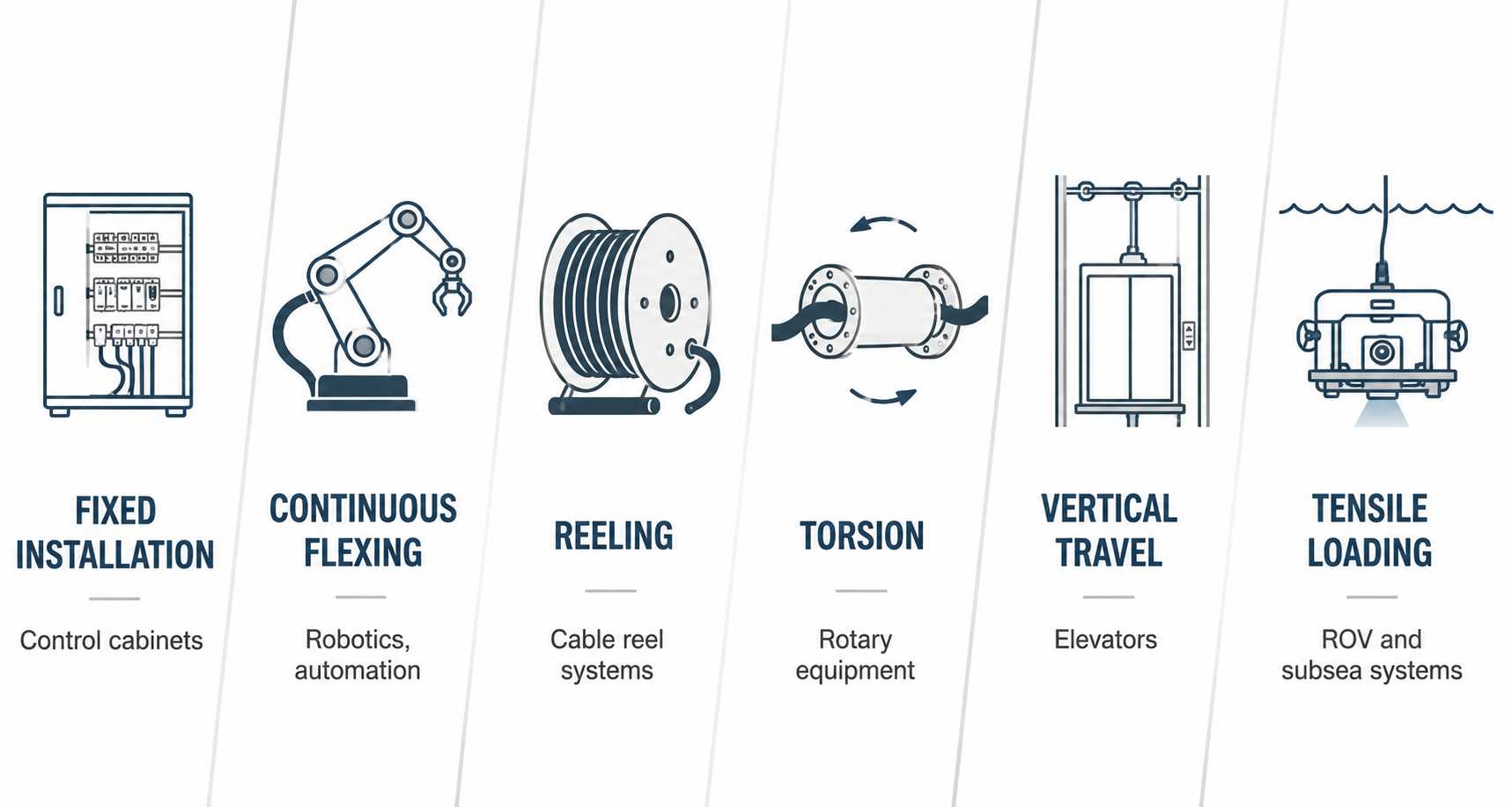
Cable movement has a major influence on cable life. Different applications require different cable constructions.
Movement Type | Typical Applications |
Fixed Installation | Control cabinets |
Continuous Flexing | Robotics, automation |
Reeling | Cable reel systems |
Torsion | Rotary equipment |
Vertical Travel | Elevators |
Tensile Loading | ROV and subsea systems |
Selecting a cable designed for the actual movement pattern helps reduce mechanical fatigue and unexpected failures.
Step 4. Select the Right Cable Family
Once the operating conditions have been identified, selecting the appropriate cable family becomes much easier.
Application | Recommended Cable |
Underwater Inspection | |
Long-Term Underwater Installation | |
Mining Equipment | Mining Cable |
Cable Reels | |
Elevators | |
Cold Environments |
Each cable family is engineered for specific operating conditions rather than general-purpose use.
Step 5. Determine Whether a Standard or Custom Cable Is Needed
Standard products can meet many common industrial applications. However, custom cable solutions become necessary when equipment requires unique electrical, mechanical, or environmental performance. Custom industrial cables may include:
Special conductor sizes
Hybrid power and fiber designs
Custom shielding
Reinforced tensile members
Specialized jacket materials
Custom cable lengths
Integrated connectors
For complex projects, working with an experienced custom cable manufacturer helps ensure the cable is optimized for the actual operating conditions rather than modified after installation.
Common Cable Selection Mistakes
Many premature cable failures are caused by incorrect selection rather than manufacturing defects. Common mistakes include:
Selecting cables based only on voltage ratings
Ignoring continuous movement requirements
Underestimating environmental exposure
Choosing materials unsuitable for chemicals or UV
Using standard cables in dynamic applications
Focusing only on purchase price instead of service life
Evaluating the complete operating environment before selecting an industrial cable can significantly improve reliability and reduce lifetime operating costs.
FAQ
How do I choose an industrial cable?
Choose an industrial cable based on the operating environment, movement type, temperature, and electrical requirements—not electrical specifications alone.
Which cable is best for underwater applications?
The best subsea cable depends on the application. ROV cables and subsea cables are designed for different depths, loads, and transmission requirements.
How important is cable flexibility?
A flexible industrial cable is essential for applications involving continuous bending, reeling, robotics, or elevator systems, helping improve service life and reliability.
When should I choose a custom cable?
Choose a custom industrial cable when standard products cannot meet your application's electrical, mechanical, or environmental requirements.
Can one cable fit every application?
No. Every industrial application has different operating conditions. The right industrial cable should always be selected based on its specific environment and performance requirements.
Related Reading
What Is an Industrial Cable? Types, Applications & Selection Guide
Need Help Selecting the Right Industrial Cable?
Our engineering team can recommend the most suitable cable construction based on your application, operating environment, and performance requirements.
Request Engineering Support
Post time:2026-07-13
