

What Is an Industrial Cable?
Types, Applications & Selection Guide
A complete guide to industrial cable types, applications, key performance features and selection considerations.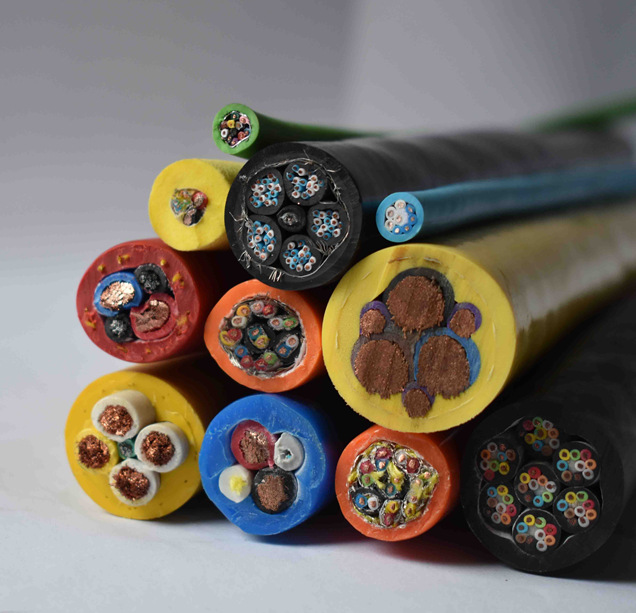
Industrial cables are engineered for applications where ordinary electrical cables cannot provide the required reliability or durability. They are designed to operate in demanding environments such as underwater systems, mining equipment, cable reels, cranes, elevators, and industrial automation.
Compared with standard cables, industrial cables must withstand continuous movement, harsh weather, abrasion, chemicals, moisture, and extreme temperatures while maintaining stable electrical performance.
This guide introduces the basic concepts of industrial cables, explains how they differ from standard cables, and provides an overview of their most common types, applications, and selection considerations.
What Is an Industrial Cable?
An industrial cable is a cable specifically designed to transmit power, control signals, communication data, or optical signals in industrial equipment and harsh operating environments.
Unlike standard electrical cables used for fixed installations, industrial cables are engineered for applications that involve continuous movement, heavy mechanical loads, challenging environmental conditions, or long-term outdoor operation.
Rather than representing a single product, industrial cable is a broad category that includes many specialized cable designs for different industries and equipment. Depending on the application, an industrial cable may prioritize flexibility, tensile strength, pressure resistance, chemical resistance, or hybrid power and data transmission.
Whether installed on an ROV, a mining machine, a cable reel, or an elevator system, the goal is the same: ensuring reliable operation where cable failure could lead to costly downtime or safety risks.
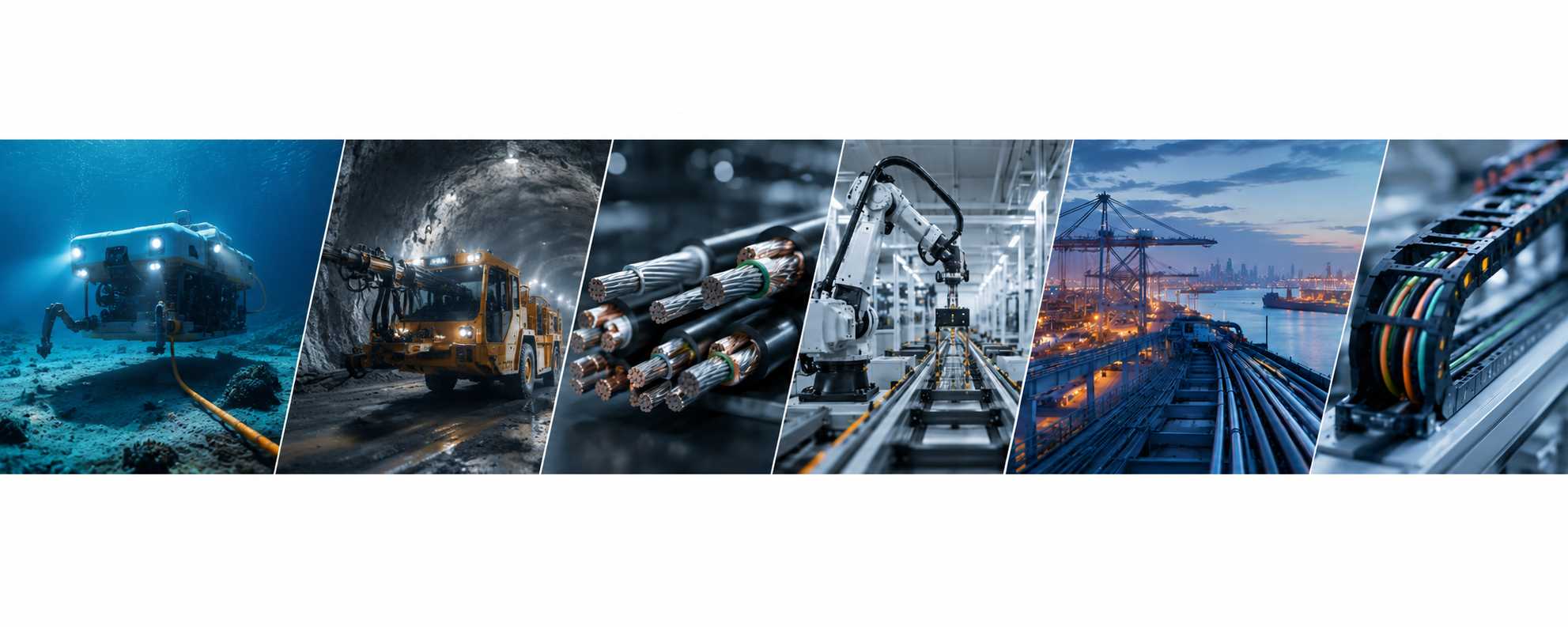
Industrial Cable vs. Standard Cable
Although industrial cables and standard electrical cables may look similar externally, they are designed for very different operating conditions. Standard cables are generally intended for fixed installations with limited mechanical stress. Industrial cables, by contrast, are expected to perform reliably under continuous motion and harsh environmental conditions throughout their service life.
Standard Cable | Industrial Cable |
Fixed installation | Dynamic applications |
Limited movement | Continuous flexing or torsion |
Indoor environments | Harsh industrial conditions |
Standard materials | High-performance engineered materials |
General-purpose use | Application-specific design |
Industrial cables typically feature stronger mechanical construction, more durable insulation systems, enhanced environmental resistance, and significantly longer service life. These characteristics make them suitable for demanding industrial equipment where reliability is critical.
Common Types of Industrial Cables
Industrial cable includes many specialized cable families, each developed for a particular application or operating environment.
ROV Cables
Designed for remotely operated underwater vehicles, ROV cables combine electrical conductors, communication elements, and often optical fibers within a flexible, durable construction.
Subsea Cables
Subsea cables provide reliable power, control, and communication for underwater installations including marine research, offshore energy, and subsea monitoring systems.
Reel Cables
Reel cables are engineered for continuous winding and unwinding on cable reels. They offer excellent flexibility, torsion resistance, and long bending life.
Mining Cables
Mining cables are built for heavy-duty equipment operating in abrasive, wet, and mechanically demanding environments.
Elevator Traveling Cables
These flexible cables provide power, control, and communication for elevator systems while withstanding constant vertical movement.
Festoon Cables
Used on cranes and material handling systems, festoon cables are designed for repeated bending during continuous operation.
Low-Temperature Cables
Low-temperature cables maintain flexibility and mechanical performance in extremely cold climates where conventional cable materials may become brittle.
Although each cable type serves different industries, all are engineered to provide reliable performance under challenging operating conditions.
Typical Industrial Cable Applications
Industrial cables are used wherever equipment operates under demanding environmental or mechanical conditions.
Marine & Underwater Systems
ROVs, sonar equipment, subsea monitoring systems, and marine research platforms require cables capable of operating underwater while transmitting power, signals, and data reliably.
Mining Equipment
Mining machinery operates in abrasive, dusty, wet, and high-impact environments. Cables used in these applications must withstand mechanical abuse while maintaining continuous operation.
Cable Reel & Crane Systems
Port cranes, container terminals, stacker reclaimers, and other heavy machinery rely on reel and festoon cables designed for constant movement.
Industrial Automation
Robots, automated production lines, sensors, and motion control systems require highly flexible cables capable of continuous dynamic operation.
Elevator Systems
Traveling cables ensure reliable communication and power transmission between moving elevator cars and control equipment.
Cold Climate Applications
Equipment operating in polar regions, refrigerated warehouses, or outdoor winter environments requires cables that remain flexible at extremely low temperatures.
Because every industry presents different operating challenges, selecting the appropriate cable construction is essential for long-term reliability.
Key Performance Characteristics of Industrial Cables
Industrial cables are designed around the specific demands of their operating environment rather than a standard construction.
Some of the most important performance characteristics include:
High Flexibility
For continuous bending and dynamic motion.
Abrasion Resistance
Protects the cable against mechanical wear caused by rough surfaces or repeated movement.
Oil & Chemical Resistance
Maintains cable integrity when exposed to industrial oils, fuels, and chemicals.
UV & Weather Resistance
Suitable for long-term outdoor installations.
Low-Temperature Performance
Maintains flexibility and durability in freezing environments.
Pressure & Water Resistance
Essential for subsea and underwater applications.
EMI Shielding
Protects sensitive communication and control signals from electromagnetic interference.
Hybrid Transmission
Combines electrical power, communication signals, and optical fibers within a single cable to simplify installation and improve system integration.
The importance of each characteristic depends on the specific application. Selecting the right combination of performance features is one of the most important steps in industrial cable design.
How to Select the Right Industrial Cable
Choosing an industrial cable begins with understanding the application rather than the cable itself. Before selecting a cable, engineers should consider several key questions:
Will the cable remain fixed or move continuously?
Is the installation indoors, outdoors, underground, or underwater?
What temperatures will the cable experience?
Will it be exposed to oil, chemicals, moisture, or UV radiation?
Does the application require power only, data transmission, or both?
Is flexibility or mechanical strength the higher priority?
What service life is expected?
A clear understanding of these operating conditions helps determine the most appropriate cable construction, materials, and performance characteristics.
For a more detailed selection guide, see How to Select the Right Industrial Cable for Harsh Environments.
Why Many Industrial Cables Are Custom Designed
Unlike standard electrical cables, many industrial cables are developed specifically for a particular machine, operating environment, or engineering project. Customization may include:
Cable diameter
Conductor size
Jacket material
Shielding structure
Tensile reinforcement
Optical fiber integration
Buoyancy adjustment
Connector compatibility
Rather than modifying an existing product, custom industrial cable design often involves optimizing the entire cable structure to improve reliability, simplify installation, and extend service life.
Learn more in Custom Industrial Cable Design & Manufacturing: From Prototype to Mass Production.
Frequently Asked Questions
What is an industrial cable?
An industrial cable is a specialized cable designed for demanding operating conditions such as continuous movement, harsh environments, and heavy mechanical loads.
Where are industrial cables commonly used?
Industrial cables are widely used in marine engineering, mining, automation, cranes, elevators, robotics, renewable energy, and other industrial applications.
What is the difference between industrial and standard cables?
Industrial cables are engineered for higher durability, flexibility, environmental resistance, and longer service life than standard electrical cables.
Can industrial cables be customized?
Yes. Many industrial applications require customized cable designs to meet specific electrical, mechanical, and environmental requirements.
How do I choose the right industrial cable?
The selection should be based on operating environment, movement, temperature, electrical requirements, installation method, and expected service life.
Every industrial application presents unique engineering challenges. Whether you need a standard industrial cable or a fully customized solution, our engineering team can recommend the most suitable cable construction based on your operating environment and performance requirements.

Post time:2026-07-05
