

ROV Umbilical Cable Selection
How to Select the Right ROV Umbilical Cable?
Selecting the right ROV Umbilical Cable requires more than matching cable size or voltage ratings. Different ROV systems have different operating purposes, deployment depths and load requirements, which directly affect cable structure, buoyancy, mechanical strength and signal performance.
Work-class ROVs and observation-class ROVs represent two common categories of underwater vehicles. While both rely on reliable tether or umbilical systems for power, communication and control, their cable requirements can be significantly different. Understanding these differences helps engineers select the right ROV cable solution for specific underwater operations.
Our engineering team can help evaluate the right cable configuration for your ROV system.

Why ROV Class Determines Umbilical Cable Requirements?
Work Class vs Observation Class
ROV Class | Typical Applications | System Characteristics | Key Umbilical Cable Requirements |
Work-Class ROV | Subsea construction, inspection, intervention, deepwater maintenance | Hydraulic tools, manipulators, subsea tooling and higher payloads | High tensile strength, higher power capacity, mechanical protection, reliable data transmission |
Observation-Class ROV | Underwater inspection, monitoring, visual surveys and research | Lightweight vehicle, lower payload, greater emphasis on maneuverability | Lightweight construction, high flexibility, low drag, buoyancy control and reliable signal transmission |
The ROV class is therefore an important starting point for cable selection. The umbilical should be engineered according to the ROV platform, operating depth, payload, power requirements and deployment conditions rather than selected as a standard cable design.
Work-Class ROV Umbilical Cable Requirements for Deepwater Operations
Work-class ROV systems require cables that can withstand higher mechanical stress and harsh subsea environments.
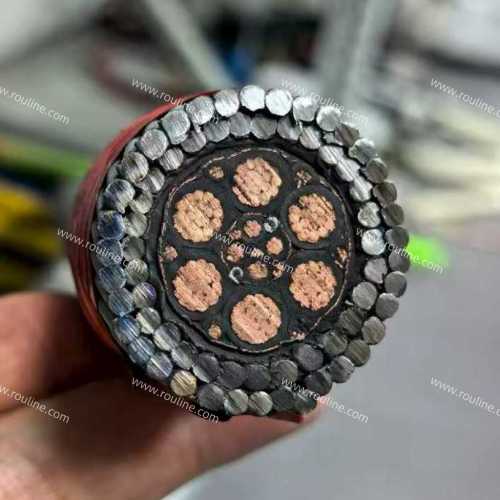
During deepwater deployment, the cable must support its own weight while handling dynamic loads caused by currents, vessel movement and ROV operations. For these applications, an armoured or reinforced ROV umbilical cable is often required. Key cable requirements include:
High Tensile Strength
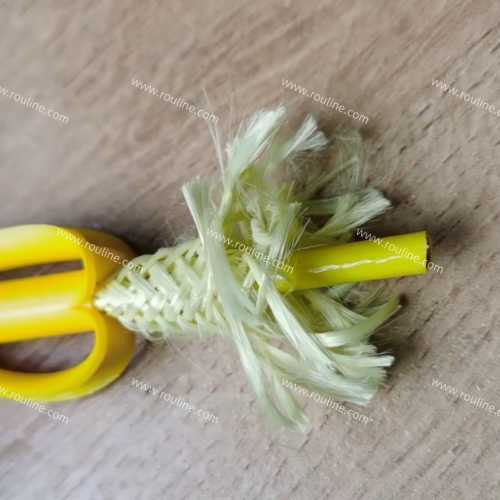
Work-class ROVs commonly operate at significant depths where cable weight becomes a major factor. A high-strength reinforcement layer, such as Steel Armor or synthetic fiber reinforcement, helps protect the cable from excessive tension during deployment and recovery.→ Armoured ROV Cable
High Power Transmission Capability
Many work-class ROVs require power for:
Hydraulic systems → Hydraulic ROV Umbilical Cable
Thrusters
Manipulators
Subsea tools
The cable design may require larger conductors to reduce voltage drop and maintain stable power delivery over long distances.
Reliable Data and Communication
Modern work-class ROVs integrate cameras, sensors and control systems. Fiber optic channels and advanced shielding structures are often incorporated to maintain reliable communication in environments with electrical interference.
For these applications, solutions such as armoured ROV cable and hybrid power-data cable designs are commonly selected.
Observation-Class ROV Tether and Lightweight Cable Requirements
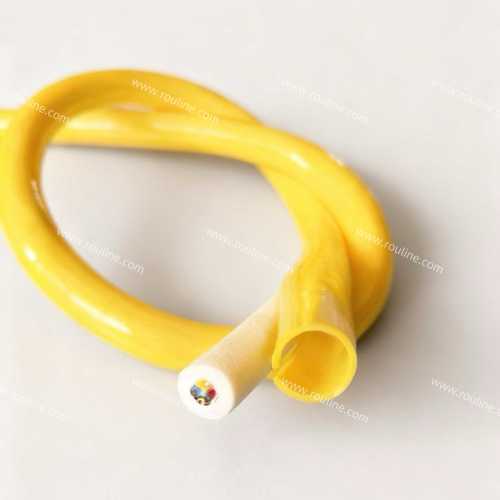
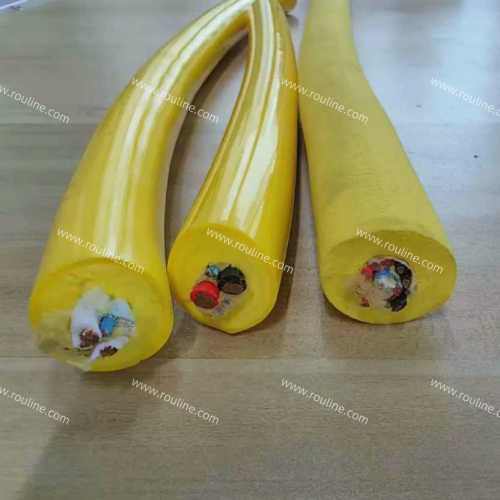
Observation-class ROVs have different priorities. Instead of supporting heavy tools, these systems focus on mobility, inspection efficiency and operational flexibility. A lightweight ROV tether cable is often preferred because it reduces drag and improves vehicle maneuverability. Important requirements include:
Lightweight and Flexible Construction
A smaller cable diameter reduces resistance in the water and allows the ROV to move more freely, especially in coastal surveys, research operations and inspection tasks. → Flexible ROV Cable
Buoyancy Control
Neutral Buoyancy is an important consideration for many observation-class systems. A properly designed buoyant or neutral buoyancy ROV cable reduces the impact of cable weight on vehicle movement and improves operational stability. → Neutral Buoyancy ROV Cable
Mechanical Protection
Although observation ROV cables are lighter, they still require protection against abrasion, bending fatigue and underwater environmental exposure. Materials such as PUR jackets provide excellent resistance against seawater, abrasion and repeated movement.
Custom ROV Umbilical Cable Solutions for Different Applications
There is no universal ROV cable design that fits every underwater operation. Work-class ROVs, observation ROVs and specialized subsea vehicles all require different combinations of strength, flexibility, buoyancy and communication capability.
As a custom industrial cable manufacturer, we provide engineered ROV umbilical cable solutions based on application requirements, including:
Operating depth
Tensile load
Power requirements
Signal and fiber configuration
Buoyancy performance
Deployment environment
Whether the project requires a heavy-duty work-class ROV cable or a lightweight observation-class ROV tether, the cable structure can be customized to achieve reliable long-term subsea performance.
Need a custom ROV umbilical cable solution? Contact our engineering team to discuss your project requirements.

Post time:2026-08-05
