

How to Select the Right ROV Cable for Data Transmission
ROV systems rely on reliable data transmission to support real-time control, video monitoring, sensor feedback, and subsea operations. The cable connecting the ROV and surface control system plays a critical role in maintaining stable communication under challenging underwater conditions.
When selecting an ROV cable for data transmission, engineers need to consider more than just transmission speed. Factors such as operating distance, bandwidth requirements, mechanical loading, flexibility, and deployment environment all influence the final cable design.
For most ROV applications, the main choices are Ethernet-based cables, fiber optic solutions, or hybrid cables that combine power and communication functions.

Understanding Data Transmission Requirements in ROV Systems
ROV data transmission requirements vary significantly depending on the application.
Inspection-class ROVs operating at relatively shallow depths may require basic communication channels for camera systems, navigation data, and control signals. In these cases, Ethernet-based solutions can provide a practical and cost-effective option.
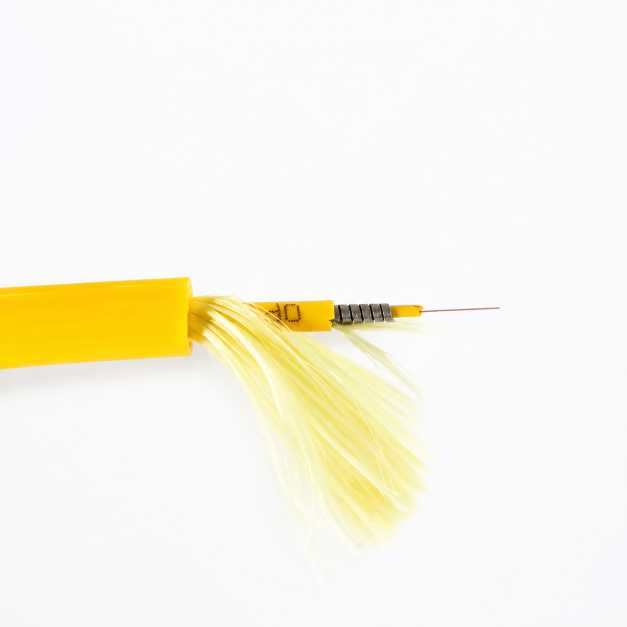
However, work-class ROVs used for offshore construction, subsea inspection, and deep-water operations typically require higher bandwidth and longer transmission distances. These systems often rely on fiber optic communication to support high-resolution video, real-time monitoring, and multiple sensor channels.
When selecting an ROV data transmission cable, key factors include:
Required communication distance
Data bandwidth requirements
Number of signal channels
Operating depth
Tether length
Mechanical loading conditions
Cable flexibility requirements
A suitable cable design must balance communication performance with the physical demands of subsea deployment.
Fiber Optic vs Ethernet ROV Cable: How to Choose the Right Solution
Both Ethernet and fiber optic technologies can be used for ROV communication systems, but they serve different application requirements.
Fiber Optic vs Ethernet ROV Cable Comparison
Selection Factor | Ethernet ROV Cable | Fiber Optic ROV Cable |
Transmission Distance | Short to medium range | Long-distance applications |
Bandwidth Capability | Suitable for standard communication | High-bandwidth data transmission |
Signal Interference Resistance | Limited by electromagnetic interference | Excellent EMI resistance |
System Integration | Simple and cost-effective | Requires optical conversion equipment |
Typical Applications | Inspection and basic monitoring ROVs | Work-class and deep-water ROV systems |
The right choice depends on the overall system requirements rather than communication technology alone.
Key Factors When Selecting an ROV Data Transmission Cable
Choosing the right ROV tether cable requires evaluating both electrical performance and mechanical requirements.
Operating Depth and Tether Length
Greater operating depth increases mechanical loading and affects cable design requirements. Longer tether lengths also increase the importance of stable data transmission.
Bandwidth Requirements
High-definition video, sonar systems, and multiple sensors require higher communication capacity. Fiber optic channels are often preferred for these applications.
Power Requirements
Many ROV systems require simultaneous power delivery and communication. Hybrid cable structures can integrate power conductors with fiber optic channels to meet these needs.
Mechanical Strength and Flexibility
ROV cables must withstand:
Repeated bending
Tensile loads
Drag forces
Dynamic movement during operation
The reinforcement structure and jacket material directly influence cable durability and service life.
Buoyancy Characteristics
Depending on the application, ROV cables may require:
Positive buoyancy
Neutral buoyancy
Negative buoyancy
Buoyancy design helps reduce drag and improve ROV maneuverability.
Why Hybrid Power and Fiber Optic ROV Cables Are Widely Used
Many advanced ROV systems require both power transmission and high-speed communication within a single tether.
A hybrid ROV cable combines multiple functions, typically integrating: Power conductors, Fiber optic communication channels, Shielding layers, and Tensile reinforcement components. This design reduces cable complexity and improves system integration.
For work-class ROV applications, a hybrid cable structure allows the tether to provide:
Continuous power supply to onboard equipment
High-speed communication for video and control data
Reliable operation over long deployment distances
The cable structure can be customized according to ROV size, operating depth, required tensile strength, and communication requirements.
Conclusion
Selecting the right ROV cable for data transmission requires a balance between communication performance, mechanical reliability, and operational requirements.
Ethernet-based cables can provide a practical solution for shorter-distance and lower-bandwidth applications, while fiber optic ROV cables are better suited for long-distance, high-bandwidth, and deep-water operations.
For many advanced subsea systems, hybrid power and fiber optic ROV cables provide an integrated solution that combines communication, power transmission, and mechanical protection.
A properly designed ROV cable helps ensure reliable operation in demanding underwater environments and supports the long-term performance of ROV systems.
Post time:2026-08-06
