

ROV Umbilical Cable for LARS:
Bending, Tension and Winch Requirements
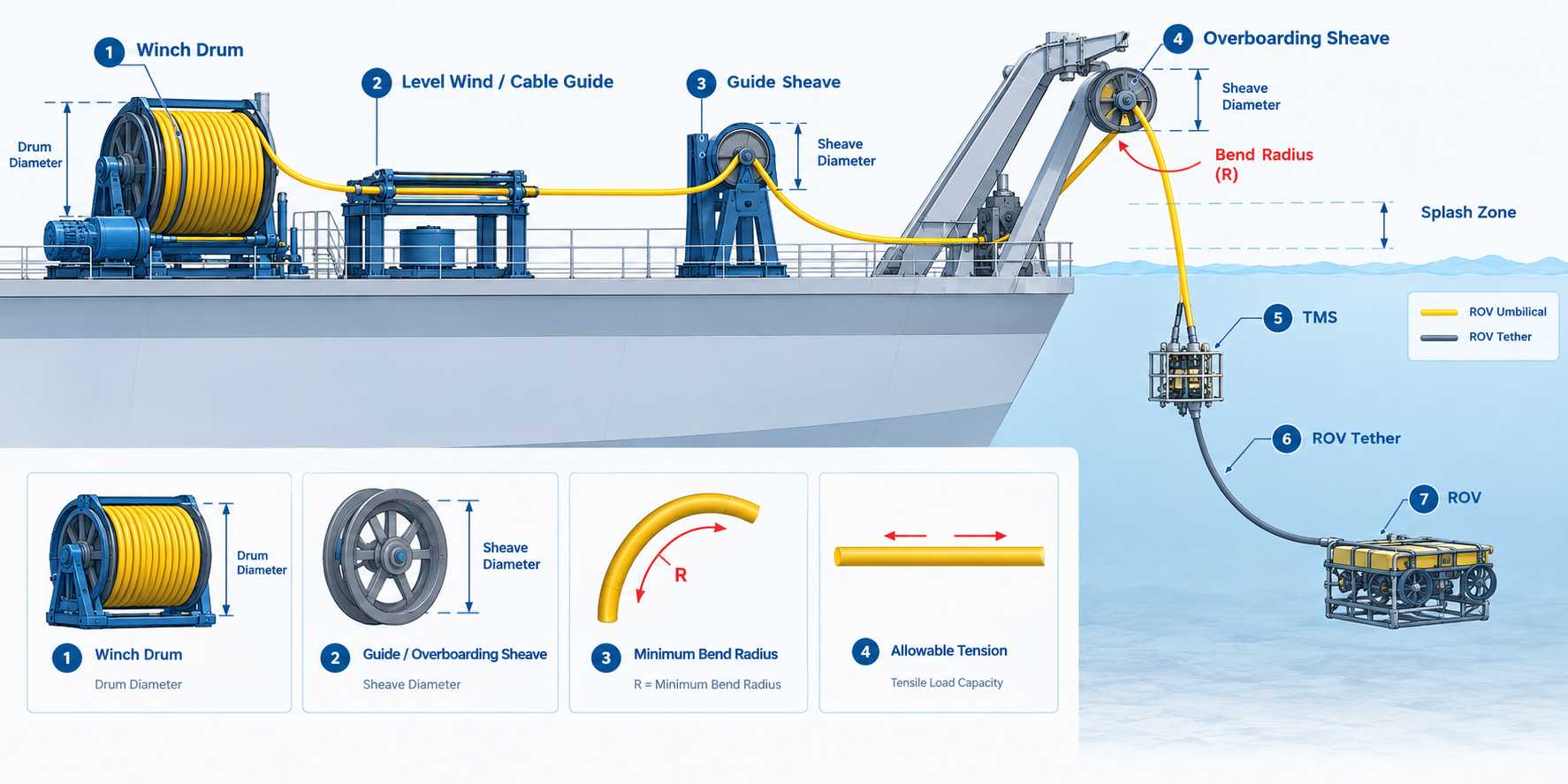
A reliable ROV umbilical cable for LARS application must be designed around the complete launch and recovery system
During deployment and recovery, the umbilical passes through winches, level-wind systems, guide sheaves and overboarding sheaves while carrying the loads generated by the ROV, TMS, cable weight, vessel motion and subsea conditions.
The key design factors are bending radius, allowable tension, winch compatibility and dynamic loading.
1. Bending Requirements for ROV Umbilicals
Bending performance is one of the most important considerations when an ROV umbilical is used with a LARS.
The minimum bend radius (MBR) should not be treated simply as a fixed multiple of cable diameter. It depends on the cable construction, armouring, internal components, tensile loading, bending frequency and whether the cable is being stored, deployed or dynamically operated. For a LARS application, consider bending performance at:
Winch drum storage
Level-wind systems
Guide sheaves
Overboarding sheaves
Static deployment
Dynamic deployment and recovery
Repeated bending during operation
When a cable passes over a sheave under tension, the interaction between bend radius, cable construction and tensile load affects mechanical performance and service life.
For this reason, the cable design should be checked against the actual LARS routing rather than selecting an umbilical based only on its outside diameter.
2. ROV Umbilical Tension Requirements
The required tensile capacity depends on the complete operating system.
Static tension can be affected by:
ROV and TMS submerged weight
Umbilical submerged weight
Deployment depth
Cable length
Cable geometry and catenary
Current and subsea conditions
ROV position
3. Winch Requirements for ROV Umbilicals
The winch directly affects the mechanical requirements of the umbilical. Before selecting or designing an ROV umbilical, the following winch parameters should be established:
Drum diameter and width
Maximum cable length
Cable outside diameter
Number of winding layers
Level-wind arrangement
Maximum line pull
Recovery speed
Acceleration and deceleration
Braking requirements
Constant-tension requirements
Heave compensation requirements
Drum Capacity and Cable Diameter
The cable outside diameter determines how much umbilical can be stored on the drum.
A larger cable may provide greater electrical capacity or mechanical strength, but it also increases drum capacity requirements and may affect winding geometry. The actual cable OD, bend radius and required deployment length should therefore be considered together when checking an existing winch.
Line Pull and Recovery Speed
Winch selection should account for the maximum expected cable tension rather than simply the static cable weight.
Recovery speed, acceleration, braking and emergency recovery can all contribute to dynamic loading. For systems using constant tension or heave compensation, the interaction between the control system and cable mechanical properties should also be considered.
4. Armouring and Mechanical Protection
Armouring can provide additional tensile strength and mechanical protection for ROV umbilicals operating in demanding subsea environments.
A steel-wire-armoured ROV umbilical may be designed to provide: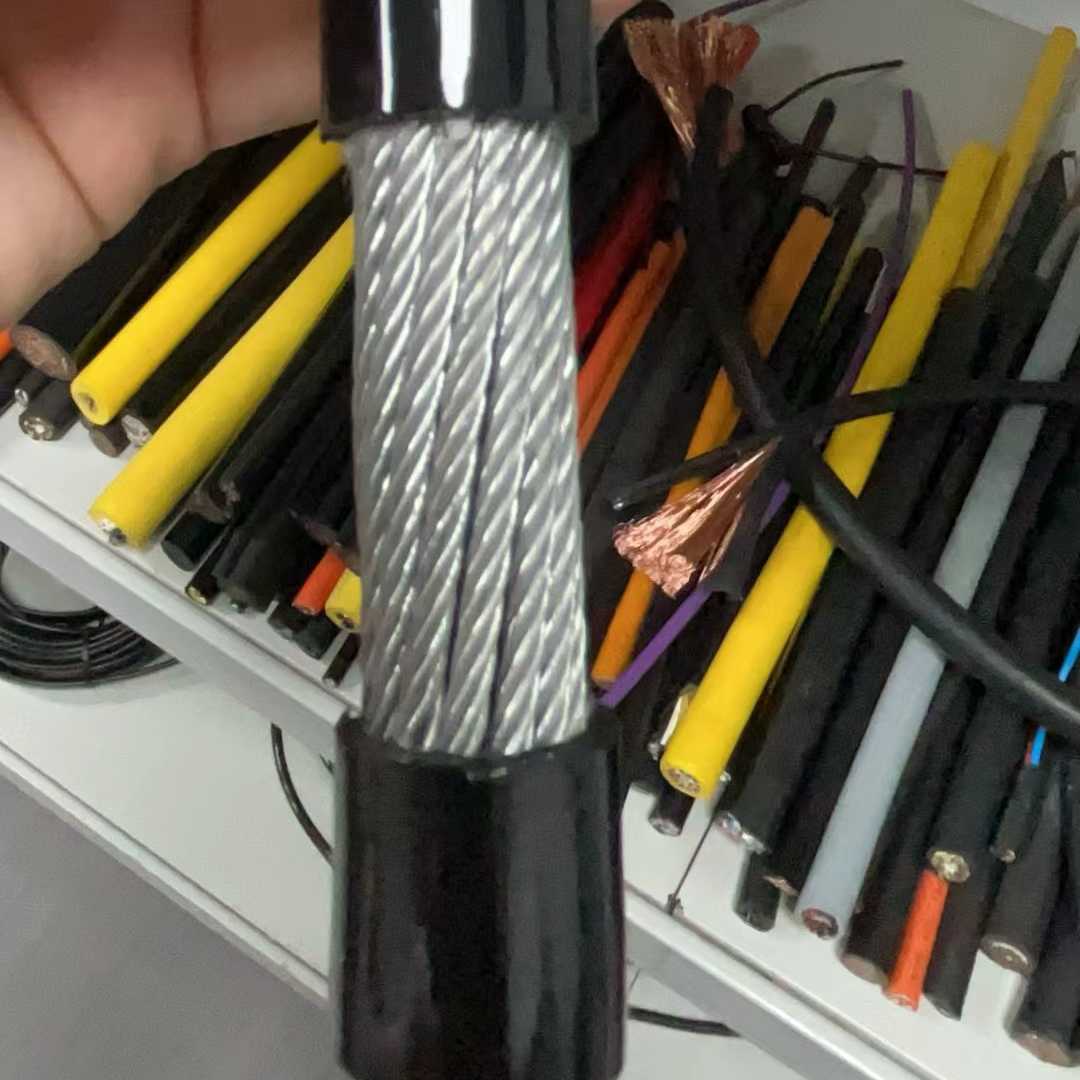
Higher tensile capacity
Mechanical protection
Improved resistance to handling loads
Protection against external impact
Controlled mechanical performance during deployment
However, armouring also affects cable stiffness, weight, outside diameter and bending behavior. The armour construction should therefore be selected together with the winch, sheave geometry and required bend radius.
For an existing LARS, the armoured cable should be checked against the actual drum and sheave configuration rather than evaluated only by tensile strength.
5. Start with the LARS, Not Just the Cable
For a new or replacement ROV umbilical, the design process should start with the operating system. The basic engineering relationship is:
① Cable Construction | ② Mechanical Performance | ③ LARS Interface | ④ Winch Operation | ⑤ Tension Control | ⑥ Operating Envelope |
Conductors | Bend Radius | Drum Diameter | Line Pull | Constant Tension | Depth |
Fiber Optics | Tensile Capacity | Sheave Diameter | Recovery Speed | Heave Compensation | Vessel Motion |
Armor | Stiffness | Groove Geometry | Acceleration | Braking | Current |
Strength Members | Torsion | Cable Routing | Winding Layers | Dynamic Load | Recovery Conditions |
Before finalizing the cable construction, define:
ROV and TMS configuration
Maximum operating depth
Required cable length
Maximum cable tension
Cable outside diameter
Power and data requirements
Optical fiber requirements
Drum dimensions
Sheave diameter and routing
Required bending performance
Recovery speed and acceleration
Vessel motion and operating conditions
This system-level approach helps ensure that the ROV umbilical works with the LARS throughout deployment, operation and recovery.
6. Custom ROV Umbilical Cable Solutions
ROV umbilicals for LARS applications can be engineered according to project-specific electrical, mechanical and environmental requirements.
Depending on the application, the cable construction can be configured with:
Power conductors
Control and signal cores
Single-mode optical fibers
Strength members
Steel-wire armouring
Water-blocking construction
Subsea-rated PUR or other suitable sheathing materials
For projects involving an existing winch or LARS, cable design can be matched to the available drum, sheave geometry, required tensile capacity, deployment depth and operating conditions.


Custom Cable Solutions | Flexible MOQ | Fast Lead Time |
Contact our engineering team with your LARS and cable requirements for a project-specific ROV umbilical design.

FAQ
What is an ROV umbilical cable for LARS?
An ROV umbilical cable for LARS connects the launch and recovery system to the subsea ROV system and is designed to withstand the electrical, mechanical and environmental loads generated during deployment and recovery.
What is the most important parameter when selecting an ROV umbilical for a winch?
There is no single parameter. Cable diameter, minimum bend radius, allowable tension, drum geometry, sheave diameter, cable length and dynamic operating conditions should be considered together.
Does a 12-ton ROV LARS require a 12-ton umbilical?
Not automatically. The required cable tensile capacity depends on the actual ROV and TMS loads, cable length, depth, submerged weight, dynamic loading and operating conditions.
Can an armoured ROV umbilical be used on an existing winch?
Yes, provided the cable's outside diameter, bend radius, tensile characteristics, stiffness and winding behavior are compatible with the existing drum, level-wind system and sheaves.
What are bespoke ROV umbilicals?
Bespoke ROV umbilicals are custom-designed cables developed around specific electrical, mechanical and environmental requirements rather than selected solely from standard cable sizes.
How does a winch affect ROV umbilical design?
The winch determines important mechanical constraints including drum diameter, winding layers, cable storage capacity, line pull, recovery speed and bending conditions.
Can you supply custom ROV umbilical cables for LARS?
Yes. Custom ROV umbilicals can be configured for project-specific power, signal, fiber, tensile, armouring, bending, depth and environmental requirements.
Post time:2026-09-24
