

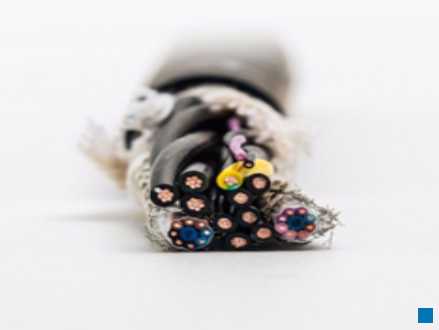
 As the core equipment for subsea inspection, ROVs are responsible for conducting high-precision integrity assessments and routine safety surveys. The key to ensuring their high-definition data transmission in real-time, stable power supply, and precise control lies in their umbilical cable. The reliability of this cable is the fundamental prerequisite for mission success. The demands placed on an umbilical cable for subsea inspection far exceed those for regular operations—it directly dictates data quality, operational efficiency, and equipment safety.
This article will explore the critical considerations that must be examined when customizing an ROV umbilical cable for subsea inspection tasks, from the perspective of a professional umbilical cable manufacturer.
1. Umbilical Cable Transmission Performance: Ensuring High Bandwidth, Low Loss & EMI Immunity
The inspection tasks of an underwater vehicle rely on the lossless, real-time transmission of HD video, sonar, and sensor data. Any data packet loss, latency, or interference can directly lead to missed inspections or misjudgments. Therefore, the design of its dedicated umbilical cable must meet the following core requirements:
(1) Fiber Optic Selection: Utilize single-mode fiber to guarantee lossless transmission of HD/UHD video streams and large data volumes over long distances and at high bandwidths.
(2) Anti-Interference Design: Implement precise cabling structures and layered shielding to minimize electromagnetic interference from power conductors on the fiber optic units, ensuring signal purity.
(3) Dynamic Stability: The fiber optic units must maintain long-term stability of their optical performance under the dynamic operating conditions of repeated bending, deployment, and retrieval.
For lightweight ROVs where observation is the primary task, we have specifically optimized the data transmission core of their umbilical cables. Learn more about how our dedicated umbilical cable for observation-class ROVs achieves signal integrity.
2. Umbilical Cable Mechanical Performance: Dynamic Fatigue Strength and Flexible Design
Inspection ROVs require agile maneuverability and prolonged operation, which poses a significant test for the cable's weight, flexibility, and durability. Therefore, its mechanical design must achieve a precise balance among the following three aspects:
(1) Lightweight & Low-Drag Design
By employing aramid fibers (e.g., Kevlar®) or high-modulus polyethylene as tensile reinforcement layers, combined with an optimized compact cross-sectional design, the cable's diameter and weight can be significantly reduced. This lowers hydrodynamic drag and substantially enhances the ROV's maneuverability and current resistance.
(2) Dynamic Fatigue Performance
To address the characteristics of frequent deployment/retrieval and abrupt stops/turns during operations, the cable structure (especially the armor and load-bearing elements) must pass stringent bending cycle fatigue tests. This ensures the cable's mechanical integrity remains undamaged after thousands of cycles over a winch drum.
(3) Abrasion Resistance & Protection
The outer sheath should be made from materials such as abrasion-resistant polyurethane or high-performance HDPE, possessing excellent resistance to abrasion, tearing, and seawater corrosion. This protects against scraping from rough seabed structures and sharp edges, as well as long-term immersion challenges.
Precise mechanical parameters are the foundation of design. Click to view detailed data on weight, diameter, minimum bending radius, and tensile strength.
3. Umbilical Cable Environmental Adaptability: VIV Suppression & Long-Term Reliability
Complex subsea environments (such as currents and complex structures) pose risks of vortex-induced vibration (VIV), entanglement, and additional fluid loading to the umbilical cable, directly affecting operational precision and the cable's service life. Accordingly, cable design must incorporate the following targeted key technologies:
(1) Outer Sheath Material: High-Density Polyethylene (HDPE) is typically recommended to achieve a balance of overall mechanical performance and corrosion resistance. For extreme wear environments, specialty abrasion-resistant polyurethane can be selected.
(2) Buoyancy Characteristics Customization: Based on the operational mode (mid-water hovering or bottom-towing), the cable's neutral/negative buoyancy is precisely adjusted via integrated buoyancy materials or weighting layers. This allows it to maintain a stable, low-drag attitude in the water, reducing the tow burden on the ROV.
(3) Termination System Reliability: The termination must possess waterproof ratings, tensile strength, and bend fatigue resistance equivalent to the cable body. This ensures the connection between the cable and the ROV or tether management system remains secure and reliable under all operating conditions, serving as the safety cornerstone of system integration.
From Requirements to Custom Solutions
In summary, the design of an ROV umbilical cable for subsea inspection is a systems engineering task that integrates high-fidelity data transmission, high-dynamic mechanical load-bearing, and high-stability fluid environmental adaptation. Only by achieving the precise coupling and balance of these three aspects can a reliable product that meets stringent application requirements be created.
To understand the underlying technical modules that constitute these customized designs (such as the integration principles of power conductors, fiber optics, and hydraulic lines), you can read our other article: 《Core Functional Modules of Umbilical Cable and Key Considerations for Customized Engineering Design》. This will help you better plan your project requirements from a fundamental principles level.
Every inspection project is unique. Our engineering team is ready to provide technical consultation and develop the most compatible umbilical cable solution based on your specific ROV model, operating depth, sea conditions, and sensor payload. Contact us to discuss your custom solution.
Copyright and Sharing Notice
© 2024 RouLine. The article "Core Functional Modules of Umbilical Cable and Key Considerations for Customized Engineering Design" is an original technical publication of our company. No individual or organization may reproduce or use this article for commercial purposes without prior authorization.
We welcome sharing on non-commercial platforms for the purpose of learning and exchange, provided that the original author and source link are clearly credited.
Article Information
Author: RouLine
Source: Knowledge
Original Link: https://www.rouline.com/key-considerations-for-rov-umbilical-cables-n.html
Publication Date: 19thJan.2026
To Learn More
If you have requirements for custom underwater equipment cables or wish to obtain more technical documentation, please contact us via our official website at www.rouline.com or by email at inquiry@rouline.com.
Post time:2026-01-19
