

What is Umbilical Cable?
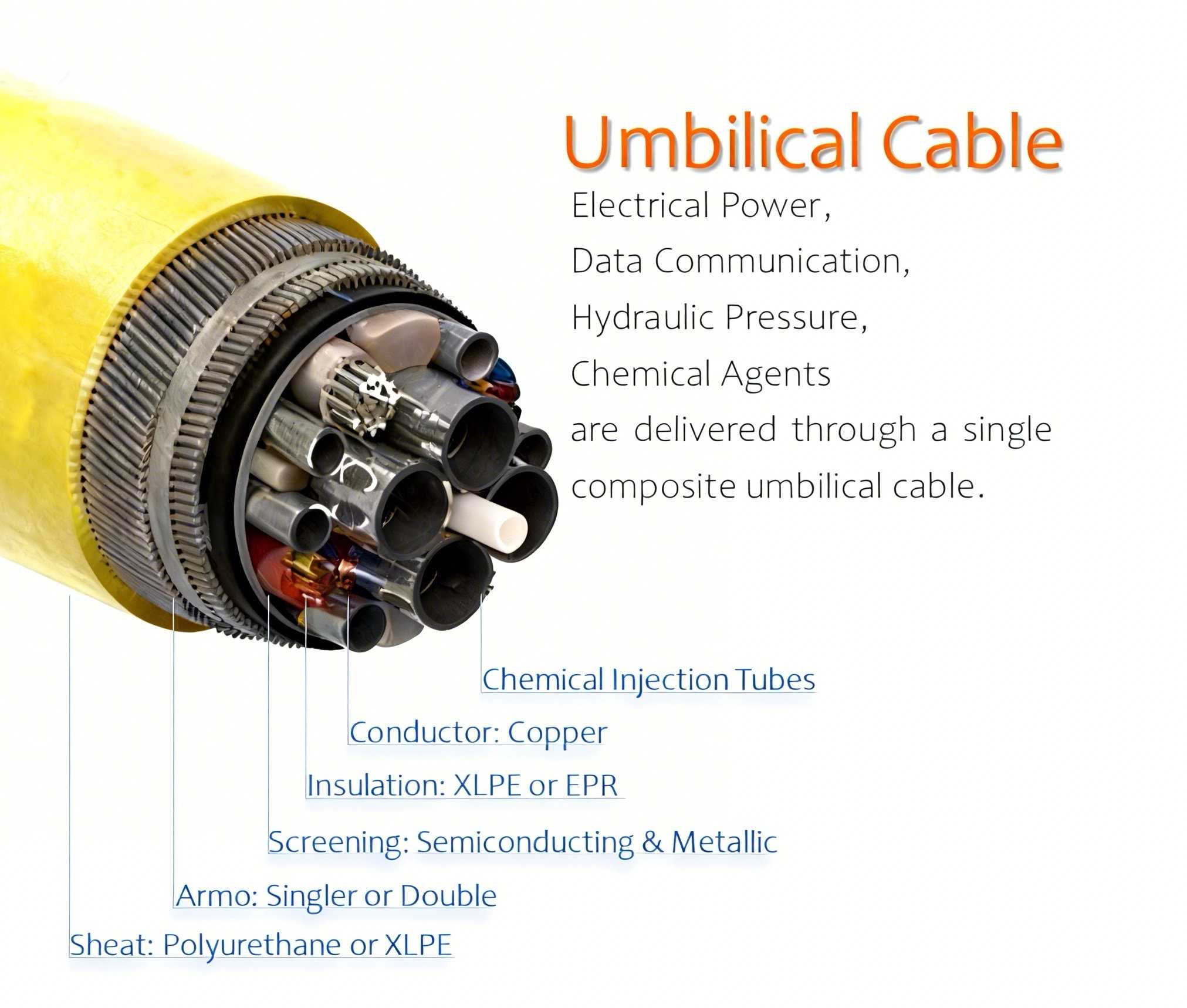
Subsea equipment operating at depths of thousands of meters requires four resource types:
electrical power
data communication
hydraulic pressure
chemical agents
These four resources are delivered through a single composite umbilical cable.
This document provides a technical description of the umbilical cable. Topics include construction and manufacturing, application areas and engineering considerations, as well as relevant standards and selection criteria.
1. Definition and Core Concept
1.1 Definition
An umbilical cable is a composite cable assembly that integrates multiple functional elements into a single armored structure. Typical elements include:
electrical power conductors
fiber optic cables for data transmission
hydraulic hoses for fluid power
chemical injection tubes for subsea processing
1.2 Functional Analogy to the Biological Umbilical Cord
The term "umbilical" is derived from the biological umbilical cord. In both cases, a dedicated connection delivers essential resources from a source to a receiver. No functional or performance comparison beyond the naming origin is implied.
1.3 Comparison with Standard Subsea Cables
| Standard Subsea Cable | Umbilical Cable | |
| Function | Single (power or signal) | Multi-functional |
| Structure | Simple (conductors + insulation + armor) | Complex (multiple element types helically stranded) |
Typical Application | Point-to-point transmission | Integrated subsea control |
1.4 Key Terminology
Dynamic Umbilical operates in the water column; subject to wave and current motion
Static Umbilical laid on the seabed; not subject to continuous motion
Steel Tube Umbilical uses small-diameter steel tubes for hydraulic or chemical service with high pressure capability
Thermoplastic Hose Umbilical uses thermoplastic hoses; more flexible, lower pressure rating
Flying Lead Short Umbilical segment connecting subsea equipment
Termination Assembly end fitting connecting umbilical to topside or subsea equipment
2. Internal Structure
A typical umbilical cable contains the following components.
2.1 Power Cores
Function: Deliver medium to high voltage electrical power to subsea pumps, compressors, control modules, and ROVs.
Construction:
Copper conductor (stranded for flexibility)
Insulation: XLPE (cross-linked polyethylene) or EPR (ethylene propylene rubber)
Screening layers: semiconducting and metallic
Sheath: polyurethane or polyethylene
Voltage range: 3 kV to 36 kV
2.2 Fiber Optic Units
Function: Enable high-speed data transmission, real-time control signals, and subsea condition monitoring.
Construction:
Optical fibers: single-mode or multi-mode
Protective buffer: acrylate or polyimide
Strength members: aramid yarn or steel wires
Protective tube: stainless steel
Data capacity: Gigabits per second range
2.3 Hydraulic Hoses
Function: Transmit hydraulic fluid under pressure to operate subsea valves, blowout preventers (BOPs), and wellhead controls.
Construction:
Inner tube: synthetic rubber or thermoplastic
Reinforcement: steel wire braid or spiral
Outer cover: abrasion-resistant polyurethane
Pressure rating: 5,000 psi to 20,000 psi (345 bar to 1,379 bar)
2.4 Chemical Injection Tubes
Function: Deliver chemicals such as methanol, corrosion inhibitors, scale inhibitors, and hydrate inhibitors to subsea wells or flowlines.
Application context: In deepwater environments, low temperatures and high pressures cause gas hydrates – ice-like solids that can block pipelines. Chemical injection prevents hydrate formation.
Construction:
Diameter: typically 1/4 inch to 1/2 inch ID
Material options: 316L stainless steel, super duplex stainless steel, thermoplastic
Corrosion-resistant alloy (CRA) required for H₂S environments
2.5 Armoring Layers
Function: Provide tensile strength, crush resistance, and protection against impact and abrasion.
Construction:
Galvanized steel wires – primary tensile strength
Steel flats – additional crush resistance for dynamic applications
Polymer sheaths – nylon, polyurethane, or polyethylene for seawater protection
Armor configurations:
Single armor – shallow water or low tension applications
Double armor – deepwater and high tension applications
Contra-helical armor – prevents torque imbalance
2.6 Fillers and Binders
Function: Maintain circular cross-section, provide structural integrity, and prevent relative movement of elements during bending.
Materials: Polypropylene yarns, EPDM rubber profiles, or thermoplastic extrusions.
3. Manufacturing Process
3.1 Process Sequence
Step 1 Component manufacturing Power cores, fiber units, hoses, and tubes produced separately
Step 2 Cabling (stranding) All components helically stranded around a central core
Step 3 Binding Tapes or yarns applied to hold the bundle
Step 4 Inner sheath Polymer layer extruded over the bundle
Step 5 Armoring Steel wires or flats wound around the cable
Step 6 Outer sheath Final polymer layer extruded
Step 7 Testing Electrical, hydraulic, optical, and mechanical tests
3.2 Technical Parameters
Lay Length Control: The helical pitch of each element is controlled to balance flexibility and stress distribution.
Tension Control: Caterpillar capstans prevent damage during extrusion.
Continuous Length Capability: Up to 20 km (12.4 miles) in a single manufacturing run.
4. Applications
4.1 Deepwater Oil and Gas
Function: Connect floating production platforms (FPSO, semi-submersible, SPAR) to subsea production systems.
Connected Equipment:
Subsea Christmas trees
Manifolds
Subsea separation systems
Subsea boosting pumps
Blowout preventers (BOPs)
Typical Water Depth: 500 m to 3,000 m (some projects exceed 3,500 m)
4.2 Remotely Operated Vehicles (ROVs)
Function: Provide power, video, and control signals to underwater robots for inspection, maintenance, and construction.
Typical Length: 1,000 m to 6,000 m
Distinguishing Feature: Smaller diameter and higher flexibility compared to production umbilicals.
4.3 Subsea Observation Networks
Function: Provide power and data connections for seabed observatories.
Monitoring Applications:
Earthquake activity
Ocean temperature and salinity
Marine biology
Tsunami early warning systems
4.4 Floating Offshore Wind
Function: Dynamic umbilicals connect floating wind turbines to subsea substations or export cables, providing power, control, and condition monitoring.
Application Context: Floating wind is deployed in deepwater locations including the North Sea, US West Coast, and Asia-Pacific regions.
4.5 Deep-Sea Mining and Scientific Research
Function: Provide power and control for seabed drills, sampling systems, and remotely operated mining vehicles.
Example Application: Nodule collectors in the Clarion-Clipperton Zone (Pacific Ocean)
5. Functional Importance
5.1 Integration Efficiency
A single umbilical cable replaces multiple independent lines:
Separate power cables
Multiple hydraulic lines
Separate chemical injection lines
Fiber optic communication cables
Advantages: Lower installation cost (one lay operation instead of four or five), reduced riser complexity, and smaller platform interface requirements.
5.2 Reliability Requirements
Failure Consequences:
Complete subsea production shutdown
Loss of control over subsea wells
Design Service Life: 10 to 15 years without replacement.
5.3 Environmental Conditions
Umbilical cables must operate under the following conditions:
Hydrostatic Pressure: Up to 500 bar (7,250 psi) at 5,000 m depth
Corrosive Agents: Seawater, H₂S, CO₂, chlorides
Dynamic Fatigue: Continuous bending from waves, vessel motion, currents
Abrasion: Contact with seabed rocks and infrastructure
Temperature: As low as -2°C (28°F) on seabed
Tensile Load: Up to 100+ tonnes during installation and operation
6. Engineering Considerations
6.1 Bending Fatigue
Issue: Dynamic umbilicals are continuously subjected to bending as the surface vessel moves. Fatigue failure can occur in copper conductors, steel armor wires, and optical fibers.
Analysis Method: Finite element analysis (FEA) modeling
Validation: Rigorous fatigue testing
6.2 High-Pressure Sealing
Issue: Termination assemblies must maintain sealing integrity under extreme pressure while accommodating cable movement.
Typical solutions:
Dual barrier seals
Metal-to-metal sealing technology
Pressure-compensated designs
6.3 Torque Balance
Issue: If armor wires are not properly wound with contra-helical lay angles, the umbilical will twist under tension, potentially damaging internal elements.
Mitigation: Balanced lay angles and finite element analysis of torque behavior.
6.4 Hydrogen Darkening in Fiber Optics
Issue: Hydrogen diffusing into fiber optic cables increases optical attenuation, reducing data transmission quality.
Mitigation:
Hydrogen-resistant fiber coatings
Carbon-coated fibers
7. Applicable Standards
Standard Organization Scope
API 17E American Petroleum Institute Subsea umbilicals
ISO 13628-5 International Organization for Standardization Design and operation of subsea umbilicals
DNV-ST-F201 DNV Dynamic riser cables and umbilicals
IEC 60794 International Electrotechnical Commission Optical fiber cables
IEEE 1580 IEEE Marine cable electrical specifications
8. Selection Criteria
8.1 Technical Parameters to Specify
Parameter Consideration
Water depth Determines hydrostatic pressure rating and armor strength
Dynamic or static service Determines fatigue design requirements
Power requirement (voltage/kVA) Determines conductor size and insulation
Hydraulic pressure required Determines hose type and burst rating
Chemical agents to be injected Determines material compatibility (CRA selection)
Data bandwidth needed Determines fiber type (single-mode vs. multi-mode) and count
Installation method Affects allowable tension and bend radius
Design life (years) Affects material selection and safety factors
8.2 Common Specification Errors
Error Consequence
Using static umbilical design for dynamic applications Premature fatigue failure
Incompatibility between chemical agents and hose/tube materials Degradation or leakage
Insufficient armor strength for installation tension Tensile failure during installation
Ignoring torque balance in armor design Twisting and internal damage
9. Manufacturing Capabilities
Note: This section lists available technical capabilities without promotional language.
9.1 Design Parameters
Parameter Range
Water depth 500 m to 4,000 m+ (deeper on request)
Service type Dynamic or static
Functional configurations Power only / Power + fiber / Power + hydraulic / Full composite
9.2 Manufacturing and Testing
Processes:
Extrusion (conductors and sheathing)
High-speed planetary cabling
Steel wire armoring (single and double)
Tests:
High voltage (AC/DC) testing
Fiber optic attenuation measurement
Hydrostatic pressure testing
Tension and bending fatigue testing
Chemical compatibility testing
9.3 Related Product Lines
Dynamic umbilicals For floating platforms and FPSOs
Static umbilicals For seabed lay applications
Flying leads Short jumpers between subsea equipment
Subsea power cables Medium voltage distribution
Subsea composite cables Power + fiber combinations
Subsea connectors and terminations End fittings and junction boxes
ROV tether cables For remotely operated vehicles
10. Technology Development Trends
10.1 Increased Water Depth
Projects are requiring umbilical cables for water depths beyond 4,000 m. This requires new armor designs and pressure compensation technologies.
10.2 All-Electric Subsea Systems
Subsea actuation is transitioning from hydraulic to electric. This changes the optimal umbilical configuration: more power conductors, fewer hydraulic hoses.
10.3 Integrated Condition Monitoring
Embedded fiber optic sensing (distributed temperature and strain sensing) enables real-time health monitoring of the umbilical itself.
10.4 Thermoplastic Composite Armor
Emerging armor materials include carbon fiber and glass fiber reinforced polymers. Properties: lightweight, corrosion-free. Applicable for ultra-deepwater and dynamic applications.
11. FAQ
Q1: What is an umbilical cable?
A composite cable integrating power conductors, fiber optics, hydraulic hoses, and chemical injection tubes into a single armored structure.
Q2: How does an umbilical cable differ from a standard subsea cable?
A standard subsea cable has a single function (power or signal). An umbilical cable has a multi-function composite structure.
Q3: What are the main applications of umbilical cables?
Deepwater oil and gas production, ROV systems, subsea observation networks, floating offshore wind, and deep-sea mining or scientific research.
Q4: What are the typical components of an umbilical cable?
Power cores, fiber optic units, hydraulic hoses, chemical injection tubes, steel wire armoring, and a seawater-resistant polymer sheath.
Q5: What is the difference between dynamic and static umbilicals?
A dynamic umbilical operates in the water column and must withstand continuous bending. A static umbilical lies on the seabed and is not subject to continuous motion.
Q6: Can umbilical cables be customized for specific projects?
Yes. Design parameters include water depth (500 m to 4,000 m+), service type (dynamic or static), armoring level, and functional configuration.
Q7: What is the typical service life of an umbilical cable?
20 to 30 years, assuming proper design, manufacturing, and installation.
Q8: Which standards apply to umbilical cable design and testing?
API 17E, ISO 13628-5, DNV-ST-F201, IEC 60794, and IEEE 1580.
Post time:2026-04-09
