Subsea Electrical Cables
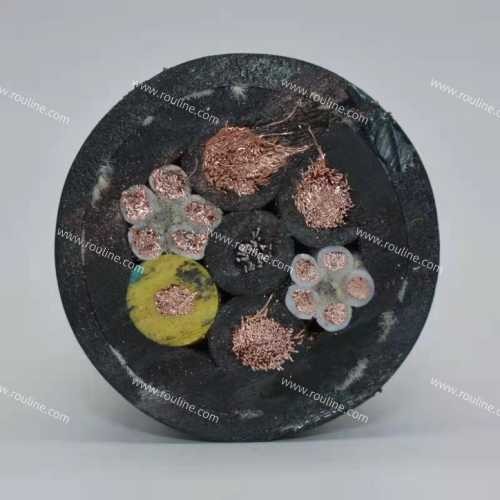
Subsea Electrical Cables
Subsea Electrical Cables is a specialized cable designed for harsh marine corrosive environments such as high salinity, withstand high pressure, seawater corrosion, and tidal cycles. As an experienced subsea cable manufacturer, RouLine designs cables with features including superior seawater corrosion resistance, complete waterproof sealing, low signal attenuation, and high electromagnetic interference (EMI) immunity.


Custom Cable Solutions | Flexible MOQ | Fast Lead Time |
Key Features
Seawater Corrosion Resistance: Withstands long-term seawater immersion and salt fog exposure. Conductor, insulation, and sheath show no significant corrosion or aging. Insulation resistance degradation≤10%. Service life designed for 5-8 years.
Complete Waterproof Sealing: Waterproof rating IP68 and above. Withstands hydrostatic pressure from 10 to 1000 bar. Longitudinal water-blocking effectiveness≥99.9%.
Signal Stability: Shielding effectiveness≥85dB. Control signal attenuation≤0.5dB/100m. Compatible with RS485, CAN Bus, Ethernet, and other signal protocols.
Mechanical Reliability: Minimum dynamic bending radius of 5D~8D. Withstands over 5 million flexing cycles. Suitable for dynamic applications such as reel winding/unwinding and moving equipment.
Conductor: multi-layer bunching/short lay length construction, anti-torsion. Compliant with IEC 60228 Class 6.
Water-Blocking Layer: Triple-seal construction: water-blocking yarn + longitudinally applied laminated aluminum-plastic tape + hot-melt adhesive. Overlap ratio ≥40%.
Outer Sheath: Abrasion-resistant, tear-resistant, hydrolysis-resistant, weather-resistant, low-friction surface material.
Specifications
Item | Specification |
Conductor | Fine-stranded, extra-flexible tinned soft copper wire |
Conductor Standard | IEC 60228 (VDE 0295) Class 6 |
Insulation | TPE, TPV, XLPE, DPEM |
Core Structure | Anti-twist layering, grouped gap filling, twisted pairs, and layered binding |
Optical Fiber | Single-mode / Multi-mode, 6–24 fibers |
Shielding | Individual Pair/Unit Shielding (aluminum foil + copper braid) Overall Shielding (copper braid). Shielding coverage density ≥85%. |
Tensile Member | Central Kevlar core, interstitial Kevlar fill, or Kevlar braid |
Outer Sheath | PUR, PE, TPU |
Working Voltage | 300/300 V – 0.6/1 kV (for higher voltage, please contact ) |
Test Voltage | 2,000 V |
Insulation Resistance | ≥20 MΩ·km at 20°C |
Minimum Bending Radius | Dynamic: 7.5 × OD; Fixed: 4 × OD |
Operating Temperature | -40°C to +105°C |
We offer solutions tailored to specific customer requirements.

Applications
The custom Subsea Electrical Cables are designed for demanding subsea and marine applications, including:
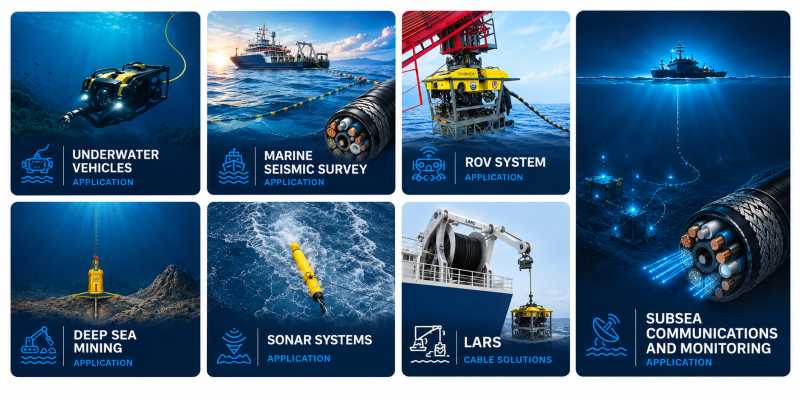
↗Marine Seismic Survey Systems


Quality Testing & Control | Manufacturing Process |
Manufacturing Process
RouLine industrial cables are manufactured through controlled processes covering extrusion, reinforcement, assembly, and final inspection. Below are examples of key manufacturing stages that demonstrate our production capabilities and quality control processes.


→Cable Core Assembly Process →Wire Stranding Process →Kevlar braiding process
RouLine ROV cables are manufactured according to project-specific requirements, from conductor and reinforcement selection to cable assembly, forming, testing, and final inspection.
More Videos of ROV Cable Manufacturing →
Test Equipment
Industrial cables manufactured by RouLine are inspected using dedicated equipment for electrical, mechanical, and environmental testing. Depending on the cable design, testing may include high-voltage testing, insulation and continuity checks, tensile testing, flexing, temperature-humidity, salt-spray, and dimensional inspection. Testing procedures can be defined according to cable construction, operating depth, voltage rating, mechanical requirements, and applicable standards. →View the Test Equipment in Use

Ordering Information
Customization: Fully supported
MOQ: project-based negotiation
Standard Lead Time: 5-10 weeks after order confirmation