

How to Choose a Reeling Cable?
Choosing the right reeling cable requires evaluating four key factors: mechanical requirements, electrical requirements, cable construction, and operating environment.
A reeling cable is designed for dynamic applications where the cable is repeatedly wound, unwound, bent, and pulled during equipment operation. Unlike fixed installation cables, it must maintain electrical performance while handling continuous mechanical stress.
For cranes, mining equipment, automated machinery, and other mobile systems, the cable must be matched to the complete reeling system. Reeling speed, travel distance, drum diameter, winding method, bending radius, environmental conditions, and duty cycle can all affect cable performance and service life.
This guide explains the key factors to consider when selecting a reeling cable for industrial applications.
1. Start with the Reeling Application
A cable used on a port crane may experience high-speed take-up and payout, while a mining machine may require greater abrasion resistance and mechanical reinforcement. Automated equipment may perform thousands of movement cycles while also requiring stable control or data transmission.
Before selecting a cable, define:
Equipment type
Reeling speed
Travel distance
Reeling frequency and duty cycle
Horizontal or vertical movement
Cable length
Drum diameter
Number of winding layers
Operating temperature
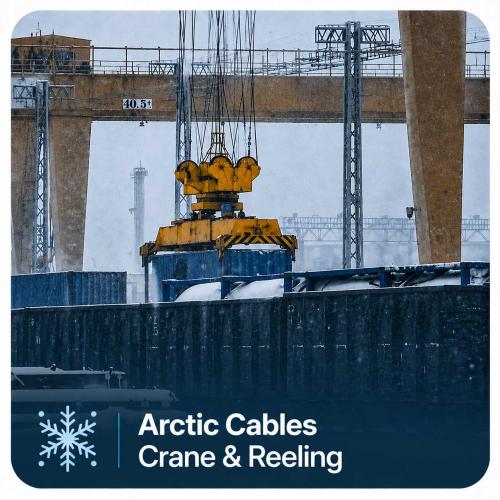
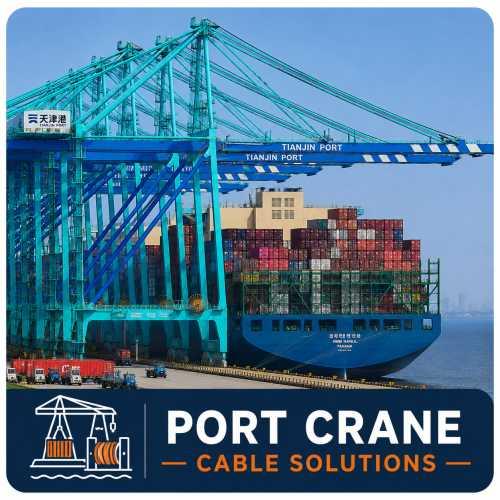
Low Temperature Crane & Reeling Solution Port Crane Cable Solutions
2. Check the Electrical Requirements
Rated Voltage and Current
Typical industrial reeling cables are available for applications such as 450/750 V and 0.6/1 kV. Medium-voltage systems require specially designed medium voltage reeling cable constructions capable of handling both electrical and mechanical stresses.
The conductor cross-section should be selected according to operating current, installation conditions, voltage drop, and equipment power requirements.
Number and Type of Cores
Determine whether the cable needs:
Power cores
Control cores
Grounding conductors
Communication elements
Fiber optics
Special auxiliary conductors
For example, an automated crane may require power and control circuits within the same cable, while a sophisticated crane control system may require a fibre optic reeling cable for high-speed data transmission.
Shielding
Shielding may be necessary where electromagnetic interference can affect control or communication signals.
Depending on the application, a cable may use Copper Braid, Foil Shielding, or a combination of shielding structures.
3. Evaluate Bending, Tensile and Torsional Loads
Mechanical performance is one of the most important differences between a dedicated reeling cable and an ordinary flexible cable.
Repeated Bending
During every winding and unwinding cycle, the cable is subjected to dynamic bending. Over time, repeated bending can cause conductor fatigue, insulation damage, or jacket cracking.
Fine-stranded Class 5 or Class 6 copper conductors are commonly considered for high-flexibility applications. The conductor stranding, core assembly, lay length, and overall cable construction should be designed for the intended movement.
Tensile Load
Long cables and vertically moving systems can generate significant tensile forces due to cable weight and equipment movement. Where tensile loading is substantial, the cable should incorporate dedicated reinforcement rather than allowing the copper conductors to carry excessive mechanical stress.
Depending on the application, reinforcement may include aramid fibers, steel wires, or other mechanical elements.
Torsion
Reeling can also generate torsional stress. Poorly controlled internal stresses may cause the cable to twist, spiral, deform, or wind unevenly on the drum.
For demanding applications, an anti-torsion reeling cable construction may incorporate optimized stranding, controlled lay lengths, and mechanical reinforcement to improve stability during repeated movement.
4. Select the Jacket Material for the Environment
The outer jacket must be selected according to the actual working environment rather than simply choosing the most flexible material.
PUR for Abrasion and Harsh Environments
PUR is widely used for demanding reeling applications. It can be particularly suitable for outdoor cranes, mining machinery, and mobile industrial equipment where the cable may encounter mechanical wear, oil, moisture, or UV exposure.
For marine and port applications, the cable construction should also be evaluated for long-term exposure to salt spray and humid environments.
Low-Temperature Applications
Outdoor equipment operating in cold regions requires more than a low nominal temperature rating. The cable must retain sufficient flexibility while undergoing dynamic movement at low temperatures.
For applications exposed to severe winter conditions, the cable material and construction should therefore be selected according to the actual minimum operating temperature.
High-Temperature Applications
Steel plants, metallurgy equipment, and other high-temperature systems may require specialized insulation and jacket materials.
Silicone or specialized fluoropolymer-based materials can be considered when the operating temperature exceeds the capability of conventional PUR or rubber compounds.
5. Match the Cable to the Reeling Drum
Drum Diameter and Bending Radius
The drum diameter must be compatible with the cable's specified minimum dynamic bending radius.
The manufacturer's dynamic bending radius should always be used instead of relying on a generic bending-radius rule.
A cable with insufficient bending capability may experience excessive mechanical stress during every winding cycle, accelerating conductor fatigue and jacket damage.
Cable Diameter and Groove
The cable outer diameter must also match the drum groove or winding arrangement.
Incorrect dimensional matching can lead to:
Cable compression
Uneven winding
Excessive abrasion
Cable overlap
Twisting or deformation
This becomes particularly important in multi-layer reeling systems.
Single-Layer vs. Multi-Layer Reeling
Single-layer winding generally provides more predictable mechanical conditions.
Multi-layer winding introduces additional compression and changes the effective winding diameter as the cable moves between layers. Therefore, cable construction and drum design should be evaluated together.
6. Consider Speed, Travel Length and Duty Cycle
Reeling speed is a major selection parameter for high-performance systems.
However, speed alone does not determine cable life. The complete operating cycle should be considered, including:
Maximum speed
Acceleration and deceleration
Travel distance
Number of cycles
Cable weight
Drum diameter
Winding layers
Operating temperature
For high-speed applications, including crane systems approaching 300m/min, the cable should be evaluated together with the complete reeling mechanism and verified against the manufacturer's technical data.
7. How to Choose a Reeling Cable for Port Cranes?
Port cranes and ship-to-shore cranes combine several demanding conditions: frequent movement, high mechanical loads, outdoor exposure, UV radiation, and salt spray. A typical port crane cable may therefore require:
High-flexibility conductors
Strong tensile reinforcement
Abrasion-resistant jacket
Weather resistance
Suitable dynamic bending performance
Shielding or communication elements where required
For high-speed container crane cables, the cable specification should be based on the actual travel speed, drum configuration, cable length, and duty cycle rather than selecting a cable only by conductor size.
For automated port crane systems, control and communication requirements may also become important, making shielding or fiber-optic integration necessary.
8. What Information Should You Provide When Ordering?
When requesting a quotation from a reeling cable manufacturer, provide as much operating information as possible.
Parameter | Example |
Application | Port crane |
Rated voltage | 0.6/1 kV |
Number of cores | 4 |
Conductor size | 16 mm² |
Cable length | 200 m |
Reeling speed | 120 m/min |
Travel distance | 80 m |
Drum diameter | Manufacturer-defined |
Winding | Single / Multi-layer |
Temperature | -40 to +80°C |
Environment | Salt spray, oil, UV |
Shielding | Required / Not required |
Tensile requirement | Application-specific |
If the standard product does not match the actual equipment, a custom construction may be required. A reeling cable manufacturer with in-house conductor stranding, extrusion, shielding, reinforcement, and electrical and mechanical testing capabilities can adjust the cable construction according to the operating conditions.
Conclusion
The correct reeling cable should be selected around the complete reeling system, not only around voltage and conductor size.
Start with the application and define the movement, speed, travel distance, duty cycle, and drum configuration. Then evaluate the cable's conductor construction, tensile reinforcement, torsional performance, jacket material, bending radius, and environmental resistance.
For demanding applications, the most important question is not simply “What cable size do I need?” , but: “What cable construction can reliably withstand the actual mechanical and environmental conditions of my reeling system?”
Providing complete operating data to the cable manufacturer allows the cable construction to be matched to the equipment and, where necessary, customized for the required performance.

Post time:2026-09-16
