

Automated Material Handling Cable Solutions
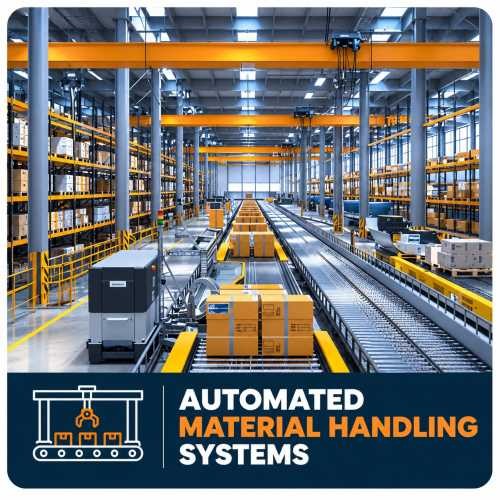
Automated Material Handling Cable Solutions
Automated material handling systems rely on reliable industrial cables to deliver power, control signals and data transmission across continuously operating equipment. We design and manufacture custom automated material handling cables for automated warehouses, conveyor systems, storage and retrieval equipment, and other material handling applications, with cable constructions tailored to equipment movement, installation conditions and operating requirements.
Cable Requirements
Automated material handling equipment requires industrial cables that can withstand continuous movement, frequent bending and demanding operating conditions. Cable selection depends on the equipment structure, cable routing, travel distance and electrical requirements.
↗ Continuous Flexibility
Cables used in automated conveyors, moving carriages and warehouse handling equipment must withstand repeated bending and continuous movement during operation.
↗ Mechanical Resistance
Cable jackets and constructions should provide resistance to abrasion, tension and mechanical stress caused by moving equipment and cable routing systems.
↗ Power and Control Transmission
Automated material handling cables must support reliable power supply, motor control, sensor signals and communication between equipment components.
↗ Signal and Data Integrity
Shielded cables may be required for control signals and data transmission, particularly in systems with variable frequency drives and electromagnetic interference.
↗ Environmental Resistance
Cable materials should be selected according to operating temperatures, humidity, oil exposure, dust and other environmental conditions.
Cable Solutions
RouLine provides custom industrial cable solutions for automated material handling systems, covering power supply, control, signal transmission and moving equipment connections. Cable constructions can be customized according to installation methods, travel distances, bending requirements and equipment operating conditions.
Recommended Cable Products
Reeling Cables
Designed for moving equipment requiring cable winding and unwinding, such as automated storage systems, transfer carriages and traveling handling equipment. Suitable for applications requiring reliable power and control transmission over long travel distances.
→ View more about our Reeling Cable
Festoon Cables
Suitable for moving machinery supplied through festoon cable systems, including overhead conveyors, transfer equipment and traveling carriages. Available in flat and round constructions, with optional shielding for control and signal applications.
→ View more about our Reeling Cable
Spreader Cables
Designed for container handling spreaders and lifting equipment requiring flexible power and control connections. Custom conductor configurations and cable constructions are available for specific equipment requirements.
→View more about our Spreader Cable
Case Study
A custom reeling cable solution engineered for Tianjin Port crane system, power transmission, high dynamic flexibility, tensile strength, and marine environmental resistance.

Reeling Cable Project for Tianjin Port
Custom Cable Engineering Capability
Custom Cable Design
Cable structures are engineered according to application requirements, including electrical configuration, mechanical loads and installation conditions.
Material Selection
Materials are selected based on environmental factors such as seawater exposure, temperature, abrasion and flexibility requirements.
Manufacturing & Assembly
From conductor preparation and insulation extrusion to shielding, armouring and final assembly, our manufacturing processes are controlled to deliver reliable custom cables for demanding industrial and subsea applications.
Testing Capability
Mechanical and electrical testing is performed to verify cable reliability and performance before delivery.

FAQ
1. What cables are used in automated material handling systems?
Automated material handling systems use power cables, control cables, signal cables and data cables. Flexible reeling and festoon cables are commonly used for moving equipment and automated handling machinery.
2. What cables are required for automated warehouse systems?
Automated warehouse systems, including AS/RS and storage and retrieval equipment, may require flexible power and control cables for moving cranes, transfer carriages and lifting mechanisms.
3. What type of cables are used in automated conveyor systems?
Automated conveyor systems typically use power cables for motors, control cables for equipment operation and shielded cables for signal transmission. Cable selection depends on conveyor movement and installation conditions.
4. Are flexible cables necessary for automated material handling equipment?
Yes. Flexible cables are recommended for equipment involving continuous movement, repeated bending or frequent travel, such as moving carriages, automated cranes and conveyor systems.
5. What is the difference between reeling cables and festoon cables?
Reeling cables are designed for winding and unwinding on cable drums, while festoon cables are installed on cable trolleys or tracks to supply moving equipment.
6. Do automated warehouse cables require shielding?
Shielding may be necessary for control, signal and data cables installed near motors, variable frequency drives or other sources of electromagnetic interference.
7. Can conveyor equipment cables be customized?
Yes. Conveyor equipment cables can be customized in conductor size, number of cores, insulation, jacket material, shielding and cable construction according to operating and installation requirements.
8. How do I select cables for automated material handling equipment?
Cable selection depends on voltage, current, travel distance, bending radius, movement speed, installation method and environmental conditions. Equipment drawings and operating specifications help determine the appropriate cable construction.


